Selenium is the chemical element with symbol Se and atomic number 34. It is a group 16 nonmetal with several allotropes and unusual photoconductive properties. Selenium is essential to human biology in trace amounts but becomes toxic when exposure is excessive.
Selenium quick facts
| Property | Value |
| Symbol | Se |
| Atomic number | 34 |
| Relative atomic mass | 78.971 |
| Group | 16 |
| Period | 4 |
| Block | p-block |
| Density | 4.809 g/cm³ |
| Melting point | 220.8°C |
| Boiling point | 685°C |
| Electron configuration | [Ar] 3d¹⁰ 4s² 4p⁴ |
| Common oxidation states | −2, +4, +6 |
| CAS number | 7782-49-2 |
| Main natural isotope | ⁸⁰Se |
Position and electron configuration
Selenium is in group 16, period 4 and the p-block. Its electron configuration is [Ar] 3d¹⁰ 4s² 4p⁴. It is chemically related to sulfur and tellurium.
See the complete CleverlySmart periodic table.
Allotropes and electrical properties
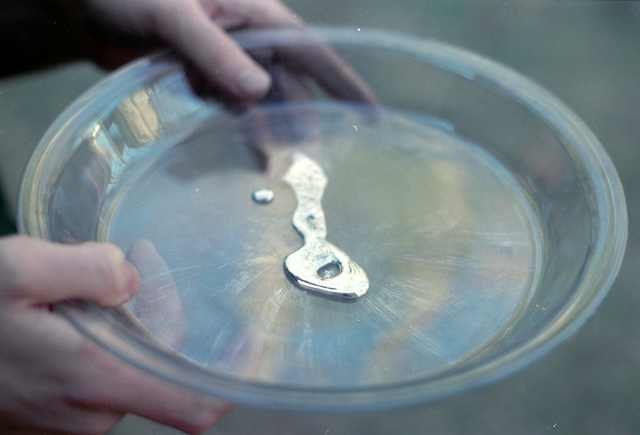
Selenium occurs in several forms. Red selenium may be amorphous or molecular, while the most stable grey form has a chain-like crystal structure and a metallic-looking appearance. Grey selenium is a photoconductor: its electrical conductivity rises when illuminated.
This light-sensitive behaviour made selenium historically important in photocells, light meters and early photocopiers, and it remains scientifically important in photovoltaic and electronic materials.
Important selenium compounds
- Selenium dioxide (SeO₂): an oxidising reagent and chemical intermediate.
- Selenides: compounds of selenium with metals or semiconducting elements; important examples occur in photovoltaic and electronic materials.
- Selenates and selenites: oxygen-containing selenium salts important in environmental chemistry, nutrition and toxicology.
- Selenium sulfide: used in certain anti-dandruff preparations under regulated formulations.
Occurrence and production
Selenium is rarely mined from dedicated selenium ores. It commonly occurs in trace amounts with metal sulfides and is recovered commercially from anode slimes produced during copper electrorefining.
Uses of selenium
- Glassmaking: selenium can neutralise unwanted green colours caused by iron or create red and bronze colours.
- Photovoltaics: selenium-containing compounds such as copper indium gallium selenide are used in thin-film solar cells.
- Pigments: selenium compounds produce durable red and orange colours in glass, ceramics and plastics.
- Electronics: selenium’s photoconductivity has been used in photocells, rectifiers and imaging technologies.
- Metallurgy: small selenium additions can modify machinability and properties of certain steels and copper alloys.
Biological role of selenium
Selenium is an essential trace nutrient for humans and many other organisms. It is incorporated into selenoproteins, including enzymes involved in antioxidant defence, thyroid-hormone metabolism and redox regulation.
The safe range is relatively narrow. Too little selenium can contribute to deficiency-related problems, while excessive intake can cause selenosis, with symptoms that may include gastrointestinal effects, hair and nail changes, fatigue and characteristic breath odour.
Selenium isotopes
Natural selenium contains several stable or extremely long-lived isotopes, including ⁷⁴Se, ⁷⁶Se, ⁷⁷Se, ⁷⁸Se, ⁸⁰Se and ⁸²Se. Selenium-80 is the most abundant. Selenium isotope ratios are useful in environmental and geochemical research.
For broader isotope information, see the CleverlySmart isotope table.
Safety
Selenium is essential only in trace quantities. Excessive selenium and several selenium compounds can be toxic. Occupational exposure to selenium dusts, fumes or volatile compounds requires appropriate ventilation and protective equipment.
Discovery and name
Swedish chemist Jöns Jacob Berzelius discovered selenium in 1817 while investigating impurities from sulfuric-acid production. He named it after Selene, the Greek goddess of the Moon, complementing tellurium, named after the Earth.
Frequently asked questions
Is selenium a vitamin?
No. Selenium is a chemical element and essential trace mineral. It is incorporated into specific proteins and enzymes.
Why is selenium used in glass?
It can counteract greenish iron colouring or deliberately produce red and bronze shades depending on composition and processing.
Selenium in biology and technology
Selenium has a narrow range between nutritional requirement and excessive exposure. In humans it is incorporated into selenoproteins, including enzymes involved in antioxidant defence and thyroid-hormone metabolism. Deficiency can impair normal physiology, while excessive intake can cause selenosis.
Selenium’s light-sensitive electrical properties led to historic use in photocells and photocopiers. Today, selenium compounds remain important in glassmaking, metallurgy and photovoltaic materials such as copper indium gallium selenide (CIGS).
Allotropes and glass applications
Selenium occurs in several forms, including red amorphous selenium and more stable grey crystalline selenium. Small amounts of selenium compounds are used to decolourise glass by counteracting unwanted green tones from iron impurities, while larger controlled additions can create red colours.
Frequently asked questions
Is selenium essential?
Yes, but only in trace amounts. Both deficiency and excess can cause health problems.
Why is selenium used in solar cells?
Selenide semiconductors can absorb light efficiently and form thin-film photovoltaic materials with useful electronic properties.