Germanium is the chemical element with symbol Ge and atomic number 32. It is a hard, brittle, grey-white metalloid and semiconductor in group 14. Germanium was crucial to the earliest semiconductor devices and remains important in infrared optics, fiber-optic systems, high-speed electronics and specialised solar cells.
Germanium quick facts
| Property | Value |
| Symbol | Ge |
| Atomic number | 32 |
| Relative atomic mass | 72.630 |
| Group | 14 |
| Period | 4 |
| Block | p-block |
| Classification | Metalloid / semiconductor |
| Density | About 5.32 g/cm³ |
| Melting point | 938.25°C |
| Boiling point | About 2820°C |
| Electron configuration | [Ar] 3d¹⁰ 4s² 4p² |
| Common oxidation states | +2, +4 |
| CAS number | 7440-56-4 |
| Stable or very long-lived natural isotopes | ⁷⁰Ge, ⁷²Ge, ⁷³Ge, ⁷⁴Ge, ⁷⁶Ge |
Position and electron configuration
Germanium is in group 14, period 4 and the p-block. Its electron configuration is [Ar] 3d¹⁰ 4s² 4p², giving it four valence electrons and chemistry that resembles both silicon and tin.
See the complete CleverlySmart periodic table.
Physical and semiconductor properties
Crystalline germanium has a diamond-cubic structure similar to silicon. It is brittle rather than ductile and has a metallic sheen. Germanium is a semiconductor with a smaller band gap than silicon, which gives it useful electronic and infrared properties.
Germanium transmits portions of infrared radiation that ordinary glass blocks. This makes polished germanium valuable for thermal-imaging lenses, infrared windows and other optical systems.
Important germanium compounds
- Germanium dioxide (GeO₂): used in optical glass and as a dopant in silica for fiber-optic cables.
- Germanium tetrachloride (GeCl₄): a volatile intermediate used to produce high-purity germanium dioxide and optical materials.
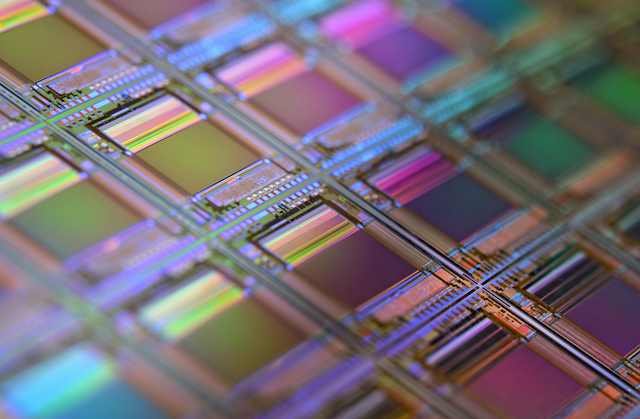
- Silicon-germanium (SiGe): an alloy/semiconductor system used in high-speed integrated circuits and radio-frequency devices.
Occurrence and production
Germanium is widely dispersed but rarely forms rich standalone ores. It can occur in zinc minerals, coal, copper ores and certain rare minerals. Commercial germanium is generally recovered as a by-product of zinc refining or from other industrial residues.
Uses of germanium
- Infrared optics: lenses and windows for thermal cameras, night vision and sensing systems.
- Fiber optics: germanium dioxide modifies the refractive index of silica glass in optical fibers.
- High-speed electronics: SiGe technology is used in radio-frequency and communications chips.
- Solar cells: germanium substrates are used in high-efficiency multi-junction photovoltaic cells, especially for space.
- Radiation detectors: high-purity germanium crystals are important gamma-ray detectors because of their excellent energy resolution.
Germanium isotopes
Natural germanium contains several isotopes, including ⁷⁰Ge, ⁷²Ge, ⁷³Ge, ⁷⁴Ge and ⁷⁶Ge. Germanium-76 is extremely long-lived and undergoes double-beta decay. Isotopically enriched germanium is important in neutrino and rare-event physics experiments.
For broader isotope information, see the CleverlySmart isotope table.
Biological role and safety
Germanium has no established essential biological role in humans. Elemental germanium is relatively unreactive, but germanium compounds can differ greatly in toxicity. In particular, unregulated germanium supplements can pose health risks and should not be confused with legitimate industrial or medical uses of germanium materials.
Discovery and name
Dmitri Mendeleev predicted germanium as eka-silicon before it was found. German chemist Clemens Winkler discovered the element in 1886 while analysing the mineral argyrodite. He named it germanium after Germany.
Frequently asked questions
Is germanium a metal?
Germanium is generally classified as a metalloid, with properties intermediate between metals and nonmetals.
Why is germanium used in infrared optics?
Because crystalline germanium transmits important infrared wavelengths while remaining mechanically workable into lenses and windows.
Germanium as a semiconductor and optical material
Germanium was central to the first generation of semiconductor electronics before silicon became dominant. It has a smaller band gap than silicon and very high carrier mobility, so germanium is still valuable in specialised high-speed devices and in advanced silicon–germanium integrated circuits.
Germanium dioxide and germanium-doped silica are important in fiber-optic communications because they help control the refractive index of optical fibres. Germanium is also transparent to portions of the infrared spectrum and is used in infrared lenses and thermal-imaging optics.
Supply and applications
Germanium rarely forms its own major ores. It is commonly recovered as a by-product from zinc ores, coal ash and certain copper deposits. This by-product dependence can make supply sensitive to changes in other mining industries.
Frequently asked questions
Why did silicon replace germanium in most electronics?
Silicon is more abundant and forms a stable, high-quality oxide that is extremely useful in transistor manufacturing.
Is germanium an essential nutrient?
No essential biological role has been established for germanium in humans, and health claims for germanium supplements should not be confused with its technological uses.