Manganese is the chemical element with symbol Mn and atomic number 25. It is a hard, brittle, silvery transition metal used mainly in iron and steel production. Manganese compounds also play important roles in batteries, pigments, catalysts and biology.
Manganese quick facts
| Property | Value |
| Symbol | Mn |
| Atomic number | 25 |
| Relative atomic mass | 54.938 |
| Group | 7 |
| Period | 4 |
| Block | d-block |
| Density | 7.3 g/cm³ |
| Melting point | 1246°C |
| Boiling point | 2061°C |
| Electron configuration | [Ar] 3d⁵ 4s² |
| Common oxidation states | +2, +3, +4, +6, +7 |
| CAS number | 7439-96-5 |
| Stable natural isotope | ⁵⁵Mn |
Position and electron configuration
Manganese is in group 7, period 4 and the d-block. Its electron configuration is [Ar] 3d⁵ 4s². The half-filled d subshell helps support a wide range of oxidation states and colourful manganese chemistry.
See the complete CleverlySmart periodic table.
Physical and chemical properties
Pure manganese is hard and brittle and is not widely used as a structural metal by itself. It oxidises in air and reacts with acids. Manganese compounds occur in many oxidation states, producing chemistry that ranges from pale Mn(II) salts to dark manganese dioxide and intensely purple permanganate.
Important manganese compounds
- Manganese dioxide (MnO₂): a black-brown oxide used in batteries, catalysts and pigments.
- Potassium permanganate (KMnO₄): a powerful purple oxidising agent used in laboratory chemistry, water treatment and specialised disinfection applications.
- Manganese sulfate (MnSO₄): used in agriculture, chemical manufacture and as a precursor for manganese materials.
- Manganese carbonates and oxides: occur naturally in ores and are used as industrial feedstocks.
Occurrence and production
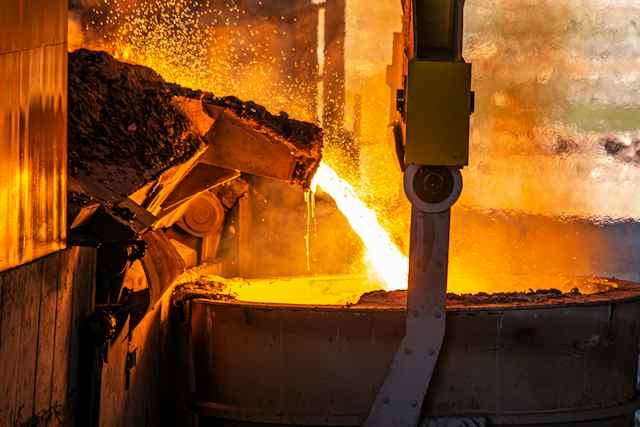
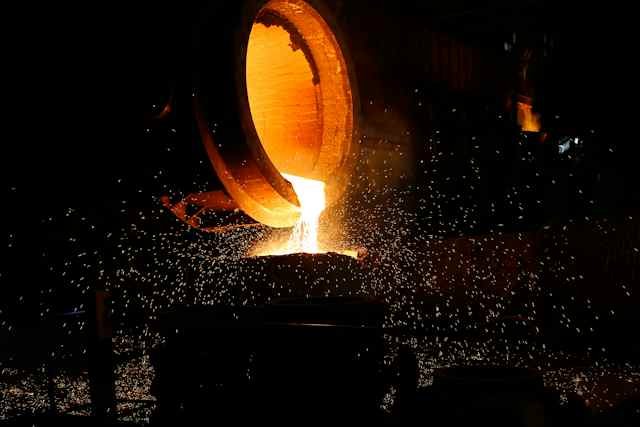
Manganese occurs in many minerals, especially pyrolusite (MnO₂), rhodochrosite and other oxide or carbonate ores. Large quantities are processed into ferromanganese and silicomanganese alloys for steelmaking.
Uses of manganese
- Steelmaking: the largest use. Manganese removes unwanted oxygen and sulfur and improves strength, toughness, hardness and wear resistance.
- Batteries: manganese dioxide is used in alkaline and zinc-carbon cells, while manganese-containing cathodes are important in several lithium-ion battery chemistries.
- Aluminium alloys: manganese improves corrosion resistance and mechanical properties in some aluminium products.
- Pigments and glass: manganese compounds can colour or decolourise glass and ceramics.
- Catalysis and oxidation chemistry: manganese oxides and permanganates are widely used chemical reagents.
Biological role
Manganese is an essential trace element. It is required by enzymes involved in metabolism, antioxidant defence and connective-tissue processes. In plants, a manganese-containing cluster is central to the water-splitting reactions of photosynthesis.
Manganese isotopes
Natural manganese consists essentially of one stable isotope, ⁵⁵Mn. Radioactive manganese isotopes such as manganese-54 are used in research and as tracers under controlled conditions.
For broader isotope information, see the CleverlySmart isotope table.
Health and safety
Manganese is nutritionally essential in small amounts, but excessive exposure can be harmful. Long-term occupational inhalation of manganese-containing dust or fumes can affect the nervous system. Industrial welding, mining and metal-processing environments therefore require appropriate exposure controls.
History and name
Manganese compounds such as manganese dioxide have been used since antiquity in pigments and glassmaking. Swedish chemist Johan Gottlieb Gahn isolated manganese metal in 1774 by reducing manganese dioxide. The element’s name is historically linked with magnesia and related mineral terminology.
Frequently asked questions
What is manganese mainly used for?
The largest use is in steelmaking, where manganese improves processing and mechanical properties.
Is manganese the same as magnesium?
No. Manganese is element 25, symbol Mn. Magnesium is element 12, symbol Mg. They are chemically distinct.
Manganese in steel and batteries
Manganese is one of the most important alloying elements in steel. It helps remove oxygen and sulfur during steelmaking and improves hardness, toughness and wear resistance. High-manganese steels can work-harden under impact, which makes them useful for crushers, rail components and heavy-duty wear parts.
Manganese dioxide (MnO₂) is also a major battery material. It is used in alkaline and zinc-carbon cells and appears in several lithium-ion cathode chemistries. Manganese is attractive because it is relatively abundant and can participate in useful redox reactions.
Biological role and exposure
Manganese is an essential trace nutrient and is required by enzymes involved in metabolism and antioxidant defence. However, chronic inhalation of excessive manganese dust or fumes can damage the nervous system, so occupational exposure must be controlled.
Frequently asked questions
Why is potassium permanganate purple?
The intense colour comes from electronic transitions in the permanganate ion, MnO₄⁻, where manganese is in the +7 oxidation state.
Is manganese the same as magnesium?
No. Manganese is Mn, atomic number 25; magnesium is Mg, atomic number 12. Their chemistry and biological roles are very different.