Chromium is the chemical element with symbol Cr and atomic number 24. It is a hard, lustrous transition metal famous for corrosion resistance, mirror-like plating and vividly coloured compounds.
Chromium quick facts
| Property | Value |
| Symbol | Cr |
| Atomic number | 24 |
| Relative atomic mass | 51.996 |
| Group | 6 |
| Period | 4 |
| Block | d-block |
| Density | 7.15 g/cm³ |
| Melting point | 1907°C |
| Boiling point | 2671°C |
| Electron configuration | [Ar] 3d⁵ 4s¹ |
| Common oxidation states | +2, +3, +6 |
| CAS number | 7440-47-3 |
| Main natural isotope | ⁵²Cr |
Position and electron configuration
Chromium is in group 6, period 4 and the d-block. Its ground-state configuration, [Ar] 3d⁵ 4s¹, is one of the classic exceptions to a simple orbital-filling prediction. The half-filled 3d subshell contributes to this arrangement.
See the complete CleverlySmart periodic table.
Physical and corrosion properties
Chromium is a hard, brittle, silvery metal with a blue-grey tint. Its best-known property is passivation: chromium exposed to oxygen develops a very thin protective oxide layer that resists further attack.
This protective behaviour explains why chromium is essential to stainless steel. When enough chromium is present in steel, the alloy develops a chromium-rich oxide film that greatly improves corrosion resistance.
Oxidation states and important compounds
Chromium has several oxidation states, but +3 and +6 are especially important. Their chemical and toxicological behaviour is very different.
- Chromium(III) oxide (Cr₂O₃): a stable green oxide used in pigments, refractories and polishing.
- Chromium(III) salts: widely used in leather tanning and coordination chemistry.
- Chromates and dichromates: contain chromium(VI) and are strong oxidising agents; many are hazardous and tightly regulated.
- Lead chromate and related pigments: historically important bright pigments but hazardous because of toxic lead and Cr(VI).
Occurrence and production
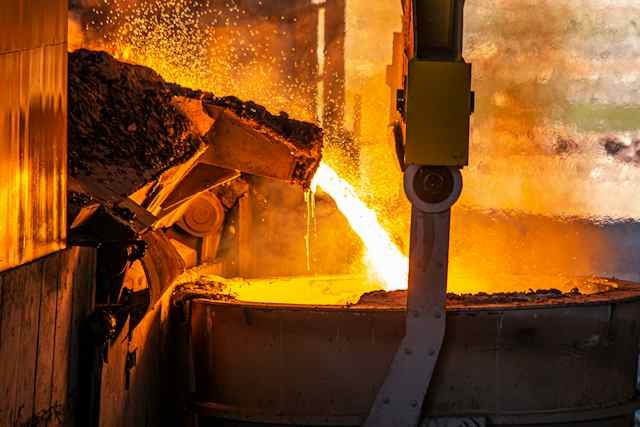
The principal chromium ore is chromite (FeCr₂O₄). Chromium is produced from chromite through high-temperature metallurgical processes. Much chromium is not used as pure metal; instead it goes directly into ferrochromium alloys for stainless-steel production.
Uses of chromium
- Stainless steel: the dominant use, providing corrosion resistance and hardness.
- Chrome plating: decorative or engineering coatings can provide hardness, wear resistance and a bright finish.
- Superalloys and tool steels: chromium improves oxidation resistance, hardenability and high-temperature performance.
- Pigments and ceramics: chromium compounds produce green, red, yellow and orange colours.
- Leather tanning: chromium(III) salts are widely used to stabilise collagen in hides.
Chromium in gemstones
Small amounts of chromium can produce intense gemstone colours. Chromium(III) gives ruby its red colour and contributes to the green colour of emerald. The exact colour depends on the host crystal and the electronic environment around chromium ions.
Chromium isotopes
Natural chromium contains four stable isotopes: ⁵⁰Cr, ⁵²Cr, ⁵³Cr and ⁵⁴Cr. Chromium-52 is the most abundant. Chromium isotope systems are used in geochemistry and planetary science.
For broader isotope information, see the CleverlySmart isotope table.
Health and safety: chromium(III) versus chromium(VI)
Different chromium species must not be treated as equivalent. Hexavalent chromium, Cr(VI), is highly toxic and carcinogenic and requires strict workplace and environmental controls. Chromium(III) compounds are generally much less hazardous, although exposure still depends on dose and chemical form.
Older sources sometimes describe chromium as an essential trace nutrient in humans. The nutritional role of chromium remains debated, so health claims should distinguish clearly between established chemistry and uncertain nutritional interpretations.
Discovery and name
French chemist Louis Nicolas Vauquelin identified chromium in the late 1790s from the mineral crocoite. The name comes from the Greek chroma, meaning colour, because chromium compounds display such a broad range of vivid colours.
Frequently asked questions
Why does stainless steel resist rust?
Chromium in the steel forms a thin, self-healing oxide film that blocks much further corrosion.
Is all chromium toxic?
No. Toxicity depends strongly on chemical form. Cr(VI) compounds are particularly hazardous, while Cr(III) compounds generally have different and lower toxicity profiles.
Chromium oxidation states and stainless steel
Chromium is central to corrosion-resistant alloys because it forms a very thin, adherent chromium oxide film on exposed surfaces. Stainless steels typically contain enough chromium for this passive layer to reform after minor damage, greatly slowing further oxidation.
Chromium chemistry depends strongly on oxidation state. Chromium(III) compounds are comparatively stable and occur in minerals and biological trace contexts, while chromium(VI) compounds such as chromates are powerful oxidants and are toxic and carcinogenic. Treating “chromium” as a single hazard therefore misses an important chemical distinction.
Chromite, pigments and surface treatments
The main commercial ore is chromite, FeCr₂O₄. Chromium compounds have been used in pigments, leather tanning and metal finishing. Traditional hexavalent-chromium coatings are increasingly controlled or replaced because of occupational and environmental risk.
Frequently asked questions
Why does chromium protect stainless steel?
Chromium rapidly forms a compact oxide layer that blocks oxygen and water from attacking the bulk alloy.
Are all chromium compounds dangerous?
No. Toxicity varies greatly with chemical form and oxidation state. Hexavalent chromium is especially hazardous, whereas trivalent chromium is much less mobile and less toxic.