Short answer: food emulsions are mixtures in which droplets of one liquid are dispersed through another liquid that normally does not mix with it. Mechanical mixing creates small droplets. An emulsifier then forms a protective interface around them, slowing the collisions that would otherwise rebuild separate oil and water layers.
Shake oil and vinegar in a jar and the dressing turns cloudy. Leave it alone, and two layers soon return. Add a suitable emulsifier and control the mixing process, and the same basic system can remain smooth long enough to become mayonnaise, milk, a sauce, butter, or ice cream.
Start with the interface, not the ingredient list
Oil and water differ in polarity. Water molecules interact strongly with one another, while most edible oils are largely nonpolar. Creating thousands of oil droplets greatly increases the contact area between the liquids. That interface costs energy, so the system tends to reduce it by letting droplets merge.
An emulsifier is amphiphilic: one region interacts more readily with water and another with oil. The molecule positions itself at the interface. This can lower interfacial tension and build a physical or electrical barrier against coalescence. Egg-yolk lecithin and milk proteins are familiar examples, although food formulators also use gums, small particles, and other surface-active materials.
This is a practical branch of chemistry, especially colloid and interface science. It explains texture without suggesting that oil and water have become a single molecular solution.
Two structures that look similar on a plate
| Emulsion type | Droplets | Continuous phase | Typical examples |
|---|---|---|---|
| Oil-in-water (O/W) | Oil | Water | Milk, mayonnaise, cream-style sauces |
| Water-in-oil (W/O) | Water | Oil or fat | Butter and some margarines |
A spoonful of each may appear uniformly creamy, yet their microstructures are reversed. The continuous phase strongly affects how a product dilutes, releases flavor, conducts heat, and feels in the mouth. Real foods can be more complicated because air cells, crystals, starch, protein networks, and solid particles may coexist with the droplets.
A kitchen experiment with three jars
Use equal amounts of water and oil in three small jars. Jar A receives no additional ingredient. Add a little mustard to Jar B. In Jar C, add mustard and shake longer. Close the jars securely, shake, and observe them at one minute, ten minutes, and one hour.
Jar A usually separates fastest. Jar B may remain cloudy longer because surface-active compounds and particles help stabilize the droplets. The longer-shaken Jar C may look finer because greater mixing energy produced smaller droplets. The outcome will vary with ingredients and technique, which is part of the lesson: stability depends on both formulation and process.
Do not taste a classroom experiment unless every ingredient, container, temperature, and handling step follows food-safety guidance. Appearance alone cannot establish safety.
What controls food-emulsion stability?
Droplet size and distribution
Smaller droplets tend to move more slowly under gravity and can produce a smoother texture. However, smaller droplets create more total surface area. If too little emulsifier is present, some new interface remains poorly protected.
Viscosity of the continuous phase
A thicker surrounding liquid slows droplet movement and collisions. Starch and gums can therefore improve physical stability without acting exactly like lecithin.
Interfacial film
Proteins or emulsifier molecules can build a layer around each droplet. Its thickness, elasticity, charge, and resistance to displacement affect whether colliding droplets merge.
Temperature, pH, and salt
Heat can unfold proteins or melt fat crystals. Freezing can concentrate solutes and press droplets together. Changes in pH or ionic strength can reduce repulsion between protein-coated droplets. Consequently, a formula that works at room temperature may fail during cooking, chilling, or storage.
Four ways an emulsion changes
| Process | What you observe | Have droplets merged? |
|---|---|---|
| Creaming or sedimentation | A concentrated layer moves upward or downward | Not necessarily |
| Flocculation | Droplets cluster like a loose bunch | No |
| Coalescence | Larger droplets form | Yes |
| Breaking | Distinct bulk layers return | Extensively |
These terms should not be treated as synonyms. A creamed emulsion can sometimes be redispersed by gentle shaking. Coalescence is harder to reverse because individual droplets have lost their boundaries.
Why mayonnaise thickens
Mayonnaise contains a high volume of oil droplets packed into an aqueous continuous phase. As droplets become numerous, they interfere with one another’s movement, and the mixture resists flow. Thickness therefore does not come only from an ingredient becoming “sticky.” It emerges from the droplet population, the interface, and the surrounding liquid.
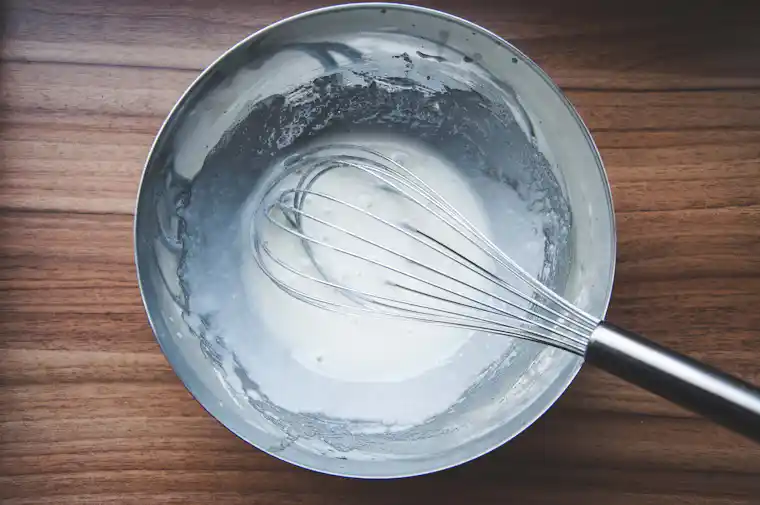
Adding oil too quickly can create new surface faster than the available emulsifier can cover it. Large oil regions then combine, and the sauce breaks. A cook can often rescue it by starting a fresh aqueous base in a clean bowl and gradually whisking the broken mixture into that base.
Food safety is a separate question
Physical stability describes separation. Microbial safety depends on factors such as acidity, water activity, salt, ingredients, processing, time, and temperature. An emulsion may remain perfectly smooth while being mishandled, or it may separate while still being microbiologically acceptable.
The FDA review of mayonnaise and salad dressings explains how the composition of the water phase and pH influence microbial stability. Follow a tested recipe, use appropriate ingredients, and obey refrigeration guidance rather than judging safety from texture. The FDA technical review provides the underlying discussion.
The same distinction appears in other preservation methods. Canning food in jars relies on validated heat and handling procedures; a stable-looking mixture is not a substitute for those controls.
Emulsions in familiar foods
- Milk: fat droplets are dispersed through an aqueous phase and supported by proteins and processing.
- Butter: water droplets sit within a continuous fat structure.
- Mayonnaise: densely packed oil droplets create a thick oil-in-water emulsion.
- Ice cream: an emulsion interacts with air bubbles, ice crystals, dissolved sugar, and a partly destabilized fat network.
- Sauces: proteins, starches, and emulsifiers can work together to control flow and separation.
Emulsion science also helps explain why ingredient order matters in baking and sauce-making. It complements practical recipes such as whole-grain bread, where water, fat, proteins, and starch contribute different structural roles. Culinary traditions use these effects even when cooks describe them through experience rather than molecular language; see examples in Indonesian cuisine.
How scientists measure an emulsion
Researchers may measure average droplet size, the full size distribution, electrical charge near the droplet surface, interfacial tension, viscosity, and changes during storage. Microscopy can reveal structure directly, while light-scattering techniques can estimate size across many droplets.
No single measurement tells the entire story. Two samples can share the same average droplet size but differ in distribution, surface composition, or resistance to heat. A widely cited critical review of food-emulsion characterization discusses why method choice should match the scientific question. An American Chemical Society teaching demonstration uses common dairy foods to make the concepts visible.
Common mistakes
- Calling an emulsion a solution. Droplets remain a separate phase rather than dissolving molecule by molecule.
- Assuming more mixing always fixes the formula. Extra surface requires enough interfacial material to protect it.
- Using “emulsifier” and “thickener” as exact synonyms. Some ingredients can do both, but the mechanisms differ.
- Treating separation as one process. Creaming, flocculation, coalescence, and breaking are distinct.
- Equating visual stability with food safety. Texture cannot reveal every microbial hazard.
- Changing several variables at once. A controlled comparison makes troubleshooting far easier.
Quiz with explanations
- What is the continuous phase?
Answer: The liquid surrounding the droplets. It determines much of the emulsion’s external behavior. - Why does shaking oil and water work only briefly?
Answer: Shaking creates droplets, but an unprotected interface encourages them to merge again. - What makes an emulsifier amphiphilic?
Answer: It contains regions with different affinities for water and oil. - Is butter normally oil-in-water?
Answer: No. Butter is commonly described as water droplets in a continuous fat phase. - Does creaming prove coalescence?
Answer: No. Droplets can migrate together while remaining individually intact. - Why can rapid oil addition break mayonnaise?
Answer: New interface forms faster than it can be adequately covered and stabilized. - Can viscosity improve stability?
Answer: Yes. A thicker continuous phase can slow droplet movement and collisions. - Does a smooth sauce prove safe storage?
Answer: No. Safety requires control of ingredients, acidity, time, temperature, and handling.
Conclusion
Food emulsions are organized, dynamic structures rather than permanently blended liquids. Mixing creates droplets; emulsifiers protect the interface; viscosity, temperature, acidity, salt, and processing determine how the structure changes. Once you separate physical stability from food safety, everyday sauces become clear demonstrations of chemistry—and easier systems to troubleshoot.
Read the Indonesian companion article: Emulsi Makanan: Mengapa Minyak dan Air Bisa Menyatu?.