Iron is the chemical element with symbol Fe and atomic number 26. It is a strong, abundant transition metal that forms the foundation of modern steelmaking and is also biologically essential for oxygen transport and many enzymes.
Iron quick facts
| Property | Value |
| Symbol | Fe |
| Atomic number | 26 |
| Relative atomic mass | 55.845 |
| Group | 8 |
| Period | 4 |
| Block | d-block |
| Density | 7.87 g/cm³ |
| Melting point | 1538°C |
| Boiling point | 2861°C |
| Electron configuration | [Ar] 3d⁶ 4s² |
| Common oxidation states | +2, +3 |
| CAS number | 7439-89-6 |
| Main natural isotope | ⁵⁶Fe |
Position and electron configuration
Iron is in group 8, period 4 and the d-block. Its electron configuration is [Ar] 3d⁶ 4s². The +2 and +3 oxidation states dominate iron chemistry, producing Fe²⁺ and Fe³⁺ compounds with different colours, redox behaviour and biological roles.
See the complete CleverlySmart periodic table.
Physical and magnetic properties
Pure iron is a lustrous grey metal that is relatively soft compared with hardened steels. Iron is ferromagnetic below its Curie temperature, which makes it fundamental to motors, transformers, generators and magnetic materials.
Iron changes crystal structure with temperature. These allotropic transformations are extremely important in metallurgy because they control how carbon and alloying elements dissolve and how steels respond to heat treatment.
Rust and corrosion
Iron readily corrodes in the presence of oxygen and water, forming hydrated iron oxides collectively known as rust. Unlike the protective oxide films on aluminium or chromium, ordinary rust is porous and can expose fresh metal to continued corrosion.
Important iron compounds
- Iron(II) oxide (FeO): an iron oxide containing Fe²⁺.
- Iron(III) oxide (Fe₂O₃): occurs in hematite and is an important iron ore and pigment.
- Magnetite (Fe₃O₄): a mixed-valence magnetic iron oxide and major ore mineral.
- Iron sulfides: include minerals such as pyrite, FeS₂.
- Iron salts and coordination complexes: widely used in water treatment, pigments, catalysis, laboratory chemistry and biological systems.
Occurrence and production
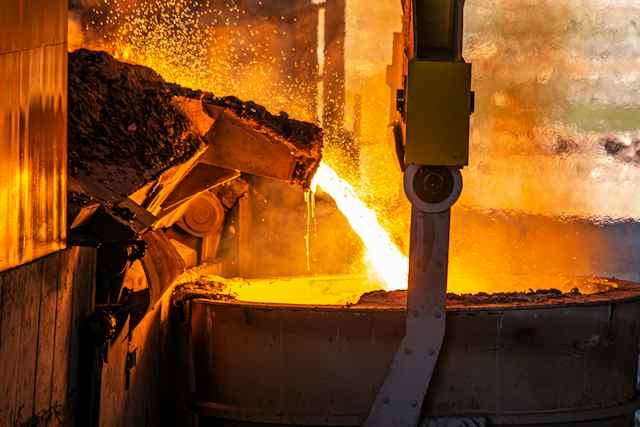
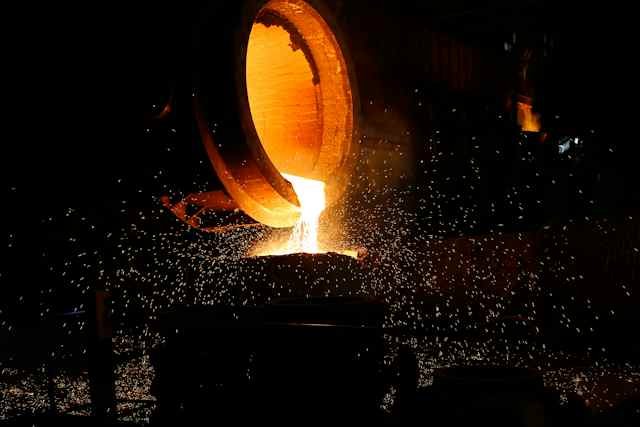
Iron is one of the most abundant elements in Earth as a whole and is a major component of the planet’s core. Commercial iron is obtained mainly from ores such as hematite and magnetite. In blast furnaces, iron oxides are reduced using carbon-derived reducing gases to produce molten iron, which is then refined into steel or cast iron.
Uses of iron and steel
- Construction: structural steel, reinforcing bar, bridges, buildings and infrastructure.
- Transport: cars, trucks, railways, ships and machinery.
- Tools and manufacturing: machine tools, industrial equipment, fasteners and countless engineered components.
- Electrical equipment: iron-rich magnetic alloys are used in transformers, motors and generators.
- Stainless steel: iron alloyed with chromium and other elements provides corrosion-resistant materials.
Biological role of iron
Iron is an essential nutrient. It is present in haemoglobin and myoglobin, where iron-containing heme groups bind oxygen. Iron is also required in cytochromes, iron-sulfur proteins and many enzymes involved in electron transfer and metabolism.
Both iron deficiency and iron excess can cause serious health problems, so biological iron is tightly regulated by the body.
Iron isotopes
Natural iron contains four stable isotopes: ⁵⁴Fe, ⁵⁶Fe, ⁵⁷Fe and ⁵⁸Fe. Iron-56 is by far the most abundant. Iron-57 is important in Mössbauer spectroscopy, while radioactive iron isotopes are used in specialised research.
For broader isotope information, see the CleverlySmart isotope table.
Safety
Bulk iron metal is widely handled safely, but fine iron powders can burn and may present dust hazards. Iron compounds vary in toxicity. Excessive iron intake can damage organs, while occupational exposure to fumes or dusts depends on the specific process and material.
History and name
Humans used meteoritic iron before developing iron smelting. The widespread production of iron tools and weapons helped define the Iron Age. The chemical symbol Fe comes from the Latin word ferrum.
Frequently asked questions
Why does iron rust?
Iron reacts electrochemically with oxygen and water, producing hydrated iron oxides that do not form a fully protective surface layer.
What is iron mainly used for?
Most iron is converted into steel for construction, transport, machinery and infrastructure.
Iron phases, steel and metallurgy
Pure iron changes crystal structure with temperature. At room temperature it is mainly alpha iron (ferrite) with a body-centred cubic structure. At higher temperatures it transforms to gamma iron (austenite), which has a face-centred cubic structure. These phase changes are fundamental to heat treatment and steelmaking.
Carbon and alloying elements alter phase stability and mechanical properties. By controlling composition, heating and cooling, metallurgists can produce steels ranging from soft sheet metal to high-strength tool steels and corrosion-resistant stainless steels.
Iron in biology and corrosion
Iron is essential in haemoglobin, myoglobin and many enzymes because Fe²⁺ and Fe³⁺ can participate in reversible electron-transfer reactions. Too little iron can impair oxygen transport, while excessive iron accumulation can also damage tissues.
Rust forms when iron reacts with oxygen and water to produce hydrated iron oxides. Unlike the protective oxide films on aluminium or chromium-rich stainless steel, ordinary rust is porous and does not stop further corrosion.
Frequently asked questions
Why is iron so important industrially?
Iron ores are abundant, iron can be reduced economically on a very large scale, and steel properties can be tuned over an exceptionally wide range.
Why does stainless steel resist rust?
Its chromium content forms a thin passive oxide layer that protects the underlying iron-rich alloy.