Aluminium is the chemical element with the symbol Al and atomic number 13. It is a lightweight, silvery-white metal in group 13 of the periodic table and is valued for its low density, corrosion resistance, malleability, conductivity and ability to form strong alloys. In American English, the element is commonly spelled aluminum; both names refer to the same element.
Aluminium is one of the most important engineering metals in modern life. It is used in aircraft, cars, buildings, electrical transmission, packaging, cookware, machinery and many other products. Although aluminium is abundant in the Earth’s crust, it is rarely found as native metal because it readily combines with oxygen and other elements.
Aluminium quick facts
| Property | Value |
| Element name | Aluminium (aluminum in US English) |
| Symbol | Al |
| Atomic number | 13 |
| Relative atomic mass | 26.982 |
| Group | 13 |
| Period | 3 |
| Block | p-block |
| State at 20°C | Solid |
| Appearance | Silvery-white metal |
| Density | 2.70 g/cm³ |
| Melting point | 660.323°C |
| Boiling point | 2519°C |
| Electron configuration | [Ne] 3s² 3p¹ |
| Common oxidation state | +3 |
| Electronegativity | 1.61 (Pauling scale) |
| CAS number | 7429-90-5 |
| Main natural isotope | ²⁷Al |
Where is aluminium on the periodic table?
Aluminium is in group 13, period 3 and the p-block. It lies below boron and between magnesium and silicon. A neutral aluminium atom has 13 protons and 13 electrons.
Its full ground-state electron configuration is 1s² 2s² 2p⁶ 3s² 3p¹, usually shortened to [Ne] 3s² 3p¹. The three outer electrons help explain why aluminium commonly forms compounds in the +3 oxidation state and the Al³⁺ ion.
See the complete CleverlySmart periodic table for all 118 chemical elements, and compare aluminium with boron (B), element 5, directly above it in group 13.
Physical properties of aluminium
Pure aluminium is a soft, lightweight and malleable metal with a silvery-white appearance. Its density is about 2.70 g/cm³, making it much lighter than iron, copper or lead. The metal melts at 660.323°C and boils at about 2519°C.
Aluminium conducts both heat and electricity. Copper has higher electrical conductivity by volume, but aluminium’s low density makes it especially useful where conductor weight matters, such as overhead power lines. Aluminium is also non-ferromagnetic and highly reflective when polished or deposited as a thin coating.
Why aluminium resists corrosion
Aluminium is chemically reactive, but it often appears highly resistant to corrosion. The reason is passivation. When fresh aluminium is exposed to air, its surface rapidly develops a thin, tightly adhering layer of aluminium oxide. This protective film isolates the underlying metal and slows further oxidation.
The oxide layer can be deliberately thickened by anodising, an electrochemical process used to improve corrosion resistance, hardness and decorative finish.
Chemical properties and reactions
Aluminium most commonly forms compounds in the +3 oxidation state. Its chemistry is strongly influenced by the protective oxide layer on the metal surface.
Reaction with oxygen
When aluminium burns in oxygen, it forms aluminium oxide:
4Al + 3O₂ → 2Al₂O₃
Reaction with acids
Once the protective oxide is overcome, aluminium can react with acids. For example, with hydrochloric acid it can produce aluminium chloride and hydrogen:
2Al + 6HCl → 2AlCl₃ + 3H₂
Reaction with strong bases
Aluminium is amphoteric, meaning that aluminium and several aluminium compounds can react with both acids and strong bases. In strongly alkaline solution, aluminium can form soluble aluminate species while releasing hydrogen gas.
Important aluminium compounds
- Aluminium oxide (Al₂O₃): also called alumina; a major industrial material and the oxide used as the feedstock for primary aluminium production.
- Aluminium hydroxide (Al(OH)₃): an amphoteric hydroxide used in chemical and industrial processes.
- Aluminium chloride (AlCl₃): an important Lewis acid and catalyst in organic chemistry.
- Aluminium sulfate (Al₂(SO₄)₃): widely used in water treatment, paper manufacture and other industrial applications.
- Aluminium silicates: common components of many rocks, clays and minerals.
Where does aluminium come from?
Because aluminium readily forms stable compounds with oxygen, metallic aluminium is uncommon in nature. The main commercial source is bauxite, an aluminium-rich ore containing hydrated aluminium oxides together with iron oxides, silica and other minerals.
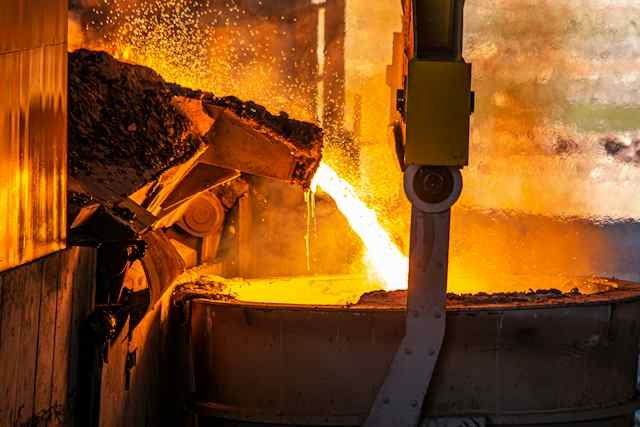
Modern primary aluminium production generally has two major stages. First, the Bayer process refines bauxite into purified aluminium oxide (alumina). Second, the Hall-Héroult process uses electrolysis to reduce alumina to metallic aluminium. The electrolytic stage requires substantial electrical energy, which is one reason aluminium recycling is so important.
Major uses of aluminium
- Aerospace: aluminium alloys are used in aircraft structures because they combine relatively low mass with useful strength.
- Automotive and transport: body panels, wheels, structural components, rail vehicles, ships and other transport systems use aluminium to reduce weight.
- Construction: window frames, façades, doors, roofing, gutters and architectural components take advantage of aluminium’s corrosion resistance and formability.
- Packaging: beverage cans, trays and very thin aluminium foil are common because the metal can be rolled into thin sheets and provides an effective barrier.
- Electrical transmission: aluminium is widely used in overhead power conductors because it conducts electricity while weighing much less than copper.
- Household and industrial products: cookware, appliances, machinery, heat exchangers, furniture and many other products use aluminium or aluminium alloys.
Aluminium alloys
Pure aluminium is relatively soft, so many engineering applications use alloys. Adding elements such as copper, magnesium, manganese, silicon or zinc can substantially change strength, corrosion resistance, hardness, weldability and heat-treatment response.
This ability to tailor properties is one of the main reasons aluminium alloys are so important in aircraft, vehicles, buildings and machinery.
Aluminium isotopes
Natural aluminium consists essentially of the stable isotope aluminium-27 (²⁷Al), which contains 13 protons and 14 neutrons. This makes aluminium a monoisotopic element in nature.
Aluminium-26 (²⁶Al) is a long-lived radioactive isotope with a half-life of about 7.17 × 10⁵ years. It decays to magnesium-26 and is important in cosmochemistry, astrophysics and studies of the early Solar System.
For a broader nuclear reference, see the CleverlySmart complete isotope table and guide to nuclides.
Biological role and safety
Aluminium has no known essential biological role in humans. Exposure occurs naturally through food, water, soil and consumer products, but the biological behavior of aluminium depends strongly on its chemical form, concentration and route of exposure.
Solid aluminium products are generally stable in normal use, but industrial handling requires appropriate precautions. Fine aluminium powder or dust can create a serious fire or explosion hazard because its large surface area allows very rapid oxidation. Molten aluminium can cause severe thermal injury, and reactions with strong acids or bases may release flammable hydrogen gas.
History of aluminium
Aluminium-containing minerals have been used since antiquity, but isolating the metal was difficult because its compounds are very stable. Danish scientist Hans Christian Ørsted produced aluminium in 1825, although his product was impure. German chemist Friedrich Wöhler later improved the method and obtained purer aluminium.
A decisive industrial breakthrough came in 1886, when Charles Martin Hall in the United States and Paul Héroult in France independently developed an electrolytic method for aluminium production. The Hall-Héroult process became the foundation of modern aluminium smelting.
Why is it called aluminium or aluminum?
The name is related to alum, a family of aluminium-containing salts known for centuries. Aluminium is the IUPAC spelling and the standard form in British and international scientific English. Aluminum is the standard American English spelling.
Frequently asked questions
What is the atomic number of aluminium?
Aluminium has atomic number 13, meaning each aluminium nucleus contains 13 protons.
What is the symbol for aluminium?
The chemical symbol for aluminium is Al.
What is aluminium’s electron configuration?
Its electron configuration is [Ne] 3s² 3p¹.
Why does aluminium not rust like iron?
Aluminium oxidises readily, but the oxide forms a thin, adherent protective layer that slows further attack. Iron rust is generally more porous and does not protect the underlying metal in the same way.
What is the main isotope of aluminium?
The naturally occurring stable isotope is ²⁷Al.
Why aluminium matters in engineering
Aluminium combines low density (about 2.70 g/cm³) with good strength when alloyed, excellent thermal and electrical conductivity, and strong corrosion resistance. The corrosion resistance comes from a thin, tightly adherent layer of aluminium oxide that forms spontaneously in air and protects the metal underneath.
Pure aluminium is relatively soft, so structural products usually contain controlled additions of magnesium, silicon, copper, zinc or manganese. Heat-treatable alloys such as the 2xxx, 6xxx and 7xxx series are important in aircraft, transport and high-strength engineering.
Production, energy and recycling
Industrial production starts with bauxite. The Bayer process refines bauxite to alumina (Al₂O₃), and the Hall–Héroult process then electrolyses molten alumina to produce aluminium metal. Primary smelting is electricity-intensive. By contrast, recycling aluminium requires only a small fraction of the energy needed for primary production, which is why beverage cans, vehicle parts and building products are widely recycled.
Frequently asked questions
Why does aluminium not rust like iron?
Aluminium does oxidise, but its oxide layer is compact and protective. Iron rust is porous and can expose fresh metal, so corrosion continues more easily.
Can aluminium be recycled repeatedly?
Yes. Aluminium can be remelted many times if the alloy stream is properly sorted and contamination is controlled.