Short answer: dendrochronology is the science of assigning calendar years to tree-growth rings by matching patterns across multiple wood samples. Its essential method is crossdating. Researchers do not trust ring counts alone because trees can form missing rings, locally absent rings, or false bands that resemble annual boundaries.
Think of a tree-ring sequence as a barcode shaped by growth. One wide ring is not distinctive, but a long pattern—narrow, narrow, wide, very narrow, medium—may align with a dated regional chronology. When independent samples repeat that pattern, a floating piece of wood can be placed on a calendar.
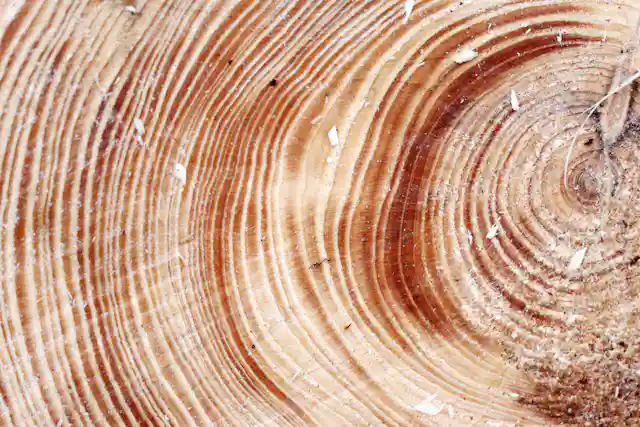
The central idea: pattern before count
Many trees add wood in seasonal cycles. Early-season cells and late-season cells can differ in size and wall thickness, creating a visible ring boundary. Yet biology and weather complicate the textbook picture.
A severe growing season may produce a ring too narrow to see on part of the stem. A temporary drought followed by renewed growth may create a false boundary within one year. Injury, competition, insects, slope, and tree age can also change ring width.
The University of Arizona Laboratory of Tree-Ring Research explains that crossdating matches growth characteristics among samples from a similar environmental area so that each ring can receive its correct year. Merely counting from the bark inward does not supply the same safeguard.
A practical dendrochronology workflow
Frame a testable question
A climate study, a historic-building investigation, and an archaeological excavation need different samples. The researcher identifies the likely species, region, preservation condition, and time range. A suitable reference chronology must represent trees that responded to broadly comparable limiting conditions.
Sample with context
Living trees can be sampled with a narrow increment borer by trained researchers who have permission. Dead logs, beams, panel paintings, charcoal, and structural timbers may offer other samples. Each core or section needs a label, location, orientation, species identification where possible, and a record of which outer layers survive.
Prepare and measure the wood
Laboratory staff mount and sand cores until cell structure and boundaries become clear. They mark rings and measure widths, often under magnification. Digital systems help store the sequence, but images do not replace knowledge of wood anatomy.
Crossdate visually and statistically
Researchers compare unusually narrow or wide intervals across many trees. A skeleton plot emphasizes signature narrow rings. Software can test correlations at different calendar positions, while analysts inspect whether the alignment makes biological and historical sense.
Replicate and document
A proposed date should survive comparison with independent samples. The final record states the dated span, the reference chronology, missing or false rings, the condition of the outer wood, measurement procedures, and uncertainty in the interpretation.
A small pattern-matching exercise
| Position | 1 | 2 | 3 | 4 | 5 | 6 | 7 |
|---|---|---|---|---|---|---|---|
| Master chronology | medium | narrow | very narrow | wide | wide | narrow | medium |
| Unknown timber | medium | narrow | very narrow | wide | wide | narrow | medium |
Suppose these master positions represent 1652–1658. The visual match suggests that span for the timber. It is not yet proof. Analysts would use a much longer run, compare measured widths, look for missing rings, test other possible alignments, and seek replication in a second timber.
The Arizona laboratory describes skeleton plotting and applications in ecology, climatology, geology, and anthropology. Sensitive trees, whose ring widths vary noticeably from year to year, often provide more distinctive crossdating patterns than trees with nearly uniform growth.
What the outer ring can—and cannot—date
A timber’s last measured ring is the last surviving year of growth in the sample. If bark and the complete outermost wood survive, researchers may estimate the felling season or year. If sapwood was trimmed away, the felling date must be later than the last preserved ring.
| Sample condition | Strongest reasonable statement |
|---|---|
| Bark edge and outer ring complete | Researchers may estimate the felling date closely |
| Some sapwood remains | Species and regional evidence may support a felling range |
| Only heartwood remains | The last preserved ring gives a “not before” boundary |
| Reused beam | Researchers must separate the wood date from the later construction date |
The U.S. National Park Service notes that archaeological dendrochronology can connect sites to specific years when crossdated regional sequences exist. Context remains decisive. A precise ring date attached to the wrong phase of a building creates a precise but incorrect historical claim.
Extending a chronology beyond living trees
A living tree has a known outer year. Its inner rings overlap with the outer rings of an older dead tree. That dead tree’s inner sequence may overlap with an archaeological timber. Repeated overlaps create a continuous chain reaching farther back than any individual tree.
This chain resembles assembling several partly overlapping timelines:
- living trees anchor recent years;
- standing dead trees and fallen logs bridge earlier periods;
- historic beams connect buildings and settlements;
- archaeological wood extends the regional sequence where preservation allows.
For a broader view of scientific specialization, see branches of science. Dendrochronology crosses botany, statistics, climatology, archaeology, conservation, and history.
Applications beyond dating a beam
Archaeology and architecture
Tree rings can help test construction phases, repairs, abandonment, and timber reuse. At sites such as the Plain of Jars, researchers select methods according to surviving materials; dendrochronology works only when suitable wood and chronologies exist.
Art history
Panel paintings and wooden objects can receive a terminus after which they must have been made. The site’s article on Mary and George Villiers includes an example in which dendrochronology contributed to dating a wooden painting panel. The ring date alone does not identify the artist.
Paleoclimate
Where growth responds strongly to moisture or temperature, calibrated ring measurements can reconstruct past conditions. Scientists remove age-related growth trends and compare ring data with instrumental records. A narrow ring is not automatically a drought; the climate signal must be demonstrated for that species and site.
NOAA’s Paleo Data Search provides access to tree-ring and other proxy datasets with metadata and citations. The climate-change trends overview explains why long baselines matter when present observations are compared with past variability.
Disturbance history
Fire scars, insect outbreaks, floods, landslides, earthquakes, and volcanic effects may leave dated changes in growth. Researchers distinguish direct injury from broader climate response and seek the same signal in several trees.
Dendrochronology and radiocarbon dating
These tools answer related questions through different evidence. Tree-ring dating can reach annual precision when a sample crossdates to an anchored chronology. Radiocarbon dating estimates the age of organic material through carbon-14 and usually yields a probability range.
Tree rings help calibrate variations in atmospheric radiocarbon. Radiocarbon, in turn, can locate a wood sequence that does not yet overlap a calendar-anchored chronology. Cornell researchers combined dendrochronology with radiocarbon wiggle-matching to refine dates for an ancient wooden structure: Cornell Chronicle.
Regional limits and tropical challenges
Dendrochronology is not equally easy everywhere. Some species do not form clear annual boundaries. In tropical environments, cambial growth may track irregular wet and dry periods rather than a simple winter-summer cycle. Wood can decay rapidly, and long master chronologies may be scarce.
Researchers can still succeed with suitable species, wood anatomy, isotopes, density, radiocarbon, and careful field calibration. The correct conclusion may be “this sample cannot be dated,” which is scientifically stronger than forcing an attractive match.
Climate relationships also differ by region. Articles on El Niño and La Niña illustrate how large-scale climate patterns can alter rainfall differently across locations.
Common mistakes
- Equating ring count with a calendar date.
- Matching a short, visually convenient pattern.
- Assuming every narrow ring records drought.
- Ignoring locally absent or false rings.
- Using a master chronology from an unsuitable species or region.
- Calling the last preserved ring the felling year when outer wood is missing.
- Dating an entire building from one reused beam.
- Sampling living trees or heritage objects without permission and conservation planning.
Dendrochronology quiz
- What is crossdating?
Matching growth patterns among samples to assign the correct calendar year to each ring. - Why can simple counting fail?
Rings may be missing, locally absent, extremely narrow, or falsely doubled. - What anchors a living-tree chronology?
The known year at the bark edge. - Does a 1700 outer ring prove that a beam was installed in 1700?
No. Outer wood may be missing, and the beam may have been stored or reused. - Why are several trees sampled?
Replication separates shared environmental patterns from individual-tree noise. - Can a wide ring always be called a wet year?
No. The limiting growth factor must be calibrated for the species and site. - How can a chronology exceed one tree’s lifespan?
Overlapping sequences from living, dead, historic, and archaeological wood extend it. - How do radiocarbon and dendrochronology cooperate?
Tree rings calibrate radiocarbon, while radiocarbon can help position unanchored ring sequences. - What is an acceptable outcome when no secure match exists?
Report the sample as undated rather than force a date.
Conclusion
Dendrochronology works because patterns repeat across trees that experienced shared conditions. Crossdating, long sequences, replication, measurement, and context turn visible rings into calendar evidence. The method can illuminate buildings, art, ecosystems, disturbances, and climate, but only when researchers respect missing wood, regional limits, reuse, and uncertainty.
Companion Indonesian guide: Dendrokronologi: Cara Ilmuwan Menentukan Tahun dari Cincin Pohon.