Silicon is the chemical element with symbol Si and atomic number 14. It is a hard, brittle, blue-grey metalloid in group 14 of the periodic table and one of the most important materials in modern electronics because pure, carefully doped silicon is a semiconductor.
Silicon is extremely abundant in Earth’s crust, but it is rarely found as the free element. Instead, it occurs mainly as silica (silicon dioxide, SiO₂) and silicate minerals in rocks, sand, clay and many common minerals.
Silicon quick facts
| Property | Value |
| Symbol | Si |
| Atomic number | 14 |
| Relative atomic mass | 28.085 |
| Group | 14 |
| Period | 3 |
| Block | p-block |
| Classification | Metalloid / semiconductor |
| State at 20°C | Solid |
| Density | 2.3296 g/cm³ |
| Melting point | 1414°C |
| Boiling point | 3265°C |
| Electron configuration | [Ne] 3s² 3p² |
| Electronegativity | 1.90 (Pauling scale) |
| CAS number | 7440-21-3 |
| Stable natural isotopes | ²⁸Si, ²⁹Si, ³⁰Si |
Where is silicon on the periodic table?
Silicon is in group 14, period 3 and the p-block. Its electron configuration is [Ne] 3s² 3p², giving it four valence electrons. That four-electron outer shell is central to silicon’s ability to form strong covalent networks and many compounds.
See the complete CleverlySmart periodic table. Silicon is directly below carbon (C) in group 14.
Physical and electronic properties
Crystalline silicon has a metallic-looking blue-grey surface, but it is brittle rather than malleable. Its diamond-cubic crystal structure is related to that of diamond and germanium. Silicon has a density of about 2.3296 g/cm³, a melting point of 1414°C and a boiling point of 3265°C.
The defining technological property of silicon is its semiconductivity. Pure silicon conducts electricity much less readily than a metal, but its conductivity can be precisely controlled by adding very small quantities of other elements. This process, called doping, makes silicon useful in diodes, transistors, integrated circuits, solar cells and sensors.
Chemical properties of silicon
Silicon commonly exhibits oxidation states of +4 and −4, although other states also occur. At room temperature crystalline silicon is relatively unreactive because its surface becomes protected by a thin oxide layer. At higher temperatures it reacts with oxygen, halogens and several other elements.
Reaction with oxygen
Silicon reacts with oxygen to form silicon dioxide:
Si + O₂ → SiO₂
Silicon dioxide forms strong three-dimensional networks and is the principal component of quartz and many forms of silica.
Important silicon compounds
- Silicon dioxide (SiO₂): occurs as quartz and silica and is fundamental to glass, ceramics, concrete and optical materials.
- Silicates: a vast family of silicon-oxygen compounds that dominate many rocks and minerals in Earth’s crust.
- Silicon carbide (SiC): an exceptionally hard, heat-resistant semiconductor used in abrasives, ceramics and high-power electronics.
- Silane (SiH₄): a reactive, flammable silicon hydride used as a precursor in semiconductor manufacturing.
- Silicon tetrachloride (SiCl₄): an industrial precursor for high-purity silica and silicon-containing materials.
Silicon versus silicone
Silicon is element 14. Silicone is not an element: it is a family of synthetic polymers containing silicon, oxygen, carbon and hydrogen. Silicones are used in sealants, lubricants, medical devices, cookware and many other products. The similar names are a frequent source of confusion.
How silicon is produced
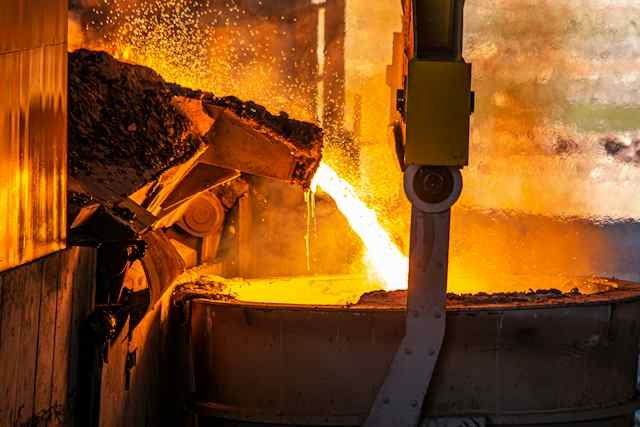
Industrial silicon is commonly produced by reducing silica with carbon at high temperature in an electric furnace. Metallurgical-grade silicon can then be purified much further when electronic or photovoltaic applications demand extremely low impurity levels.
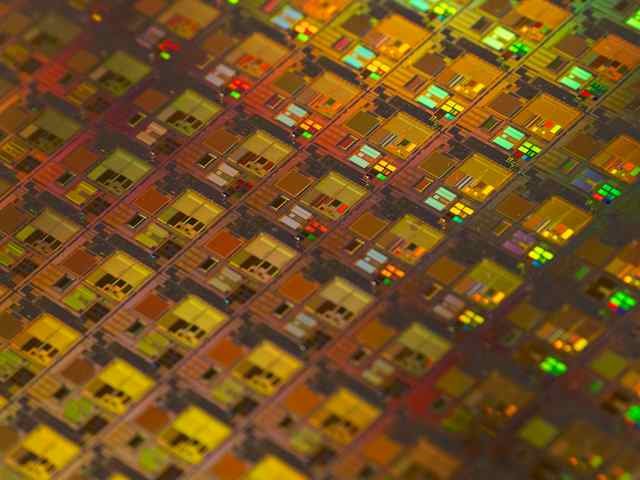
Semiconductor-grade silicon is refined through chemical and physical processes and grown into high-purity single crystals or other controlled forms. Tiny, deliberate additions of dopants such as boron or phosphorus then create p-type or n-type semiconductor regions.
Uses of silicon
- Microelectronics: computer processors, memory chips, power devices, sensors and integrated circuits.
- Solar energy: crystalline silicon is the dominant material used in many photovoltaic cells.
- Alloys: ferrosilicon and aluminium-silicon alloys are important in steelmaking, casting and engineering.
- Glass and ceramics: silica and silicates are essential raw materials.
- Construction: silicate minerals are major ingredients of cement, concrete, bricks and ceramics.
- Advanced materials: silicon carbide and other silicon compounds are used in high-temperature, abrasive and electronic applications.
Silicon isotopes
Natural silicon contains three stable isotopes: ²⁸Si, ²⁹Si and ³⁰Si. Silicon-28 is by far the most abundant. Silicon-29 has a nuclear spin that makes it valuable in nuclear magnetic resonance studies of silicon-containing materials.
Several radioactive silicon isotopes are also known. For a wider nuclear overview, see the CleverlySmart complete isotope table and guide to nuclides.
Biological and environmental importance
Silicon is widespread in soils, rocks and natural waters. Some organisms, including diatoms, use silica to build rigid structures. In humans, silicon is present in small amounts, but it is not generally classified in the same way as established essential mineral nutrients such as iron or zinc.
Elemental silicon should not be confused with respirable crystalline silica dust. Occupational inhalation of fine crystalline silica can cause serious lung disease, including silicosis, and exposure therefore requires strict dust controls.
History and name
Silica and silicate minerals have been used since prehistoric times in stone tools, glass and ceramics. The element itself was isolated in a relatively pure form by Swedish chemist Jöns Jacob Berzelius in 1824. The name is derived from the Latin silex or silicis, meaning flint or hard stone.
Frequently asked questions
Is silicon a metal?
Silicon is usually classified as a metalloid. It has a metallic appearance but is brittle and has semiconductor electrical behavior.
Why is silicon used in computer chips?
Its semiconductor properties can be precisely controlled by doping, and silicon forms a stable insulating oxide, SiO₂, that is extremely useful in electronic device fabrication.
What is silicon’s electron configuration?
[Ne] 3s² 3p².
Silicon as a semiconductor
Crystalline silicon has a diamond-cubic crystal structure and behaves as an indirect-band-gap semiconductor with a band gap of about 1.12 eV at room temperature. Pure silicon conducts electricity only moderately, but its electrical behaviour can be precisely controlled by adding tiny amounts of dopants.
Phosphorus or arsenic can produce n-type silicon by supplying extra electrons, while boron creates p-type silicon by introducing electron vacancies called holes. Carefully patterned p–n junctions are the foundation of diodes, transistors, integrated circuits and most conventional solar cells.
Silicon in glass, ceramics and solar technology
Silicon dioxide (SiO₂) is the major component of quartz and a key raw material for glass. Silicates dominate many rocks and minerals in Earth’s crust. High-purity silicon is produced on a much smaller scale for electronics and photovoltaic cells, where crystal quality and impurity control are critical.
Frequently asked questions
Is silicon the same as silicone?
No. Silicon is the chemical element Si. Silicone is a family of synthetic polymers built from silicon–oxygen backbones and organic side groups.
Why is silicon used for computer chips?
It is abundant, forms an excellent insulating oxide, and can be doped and manufactured with extraordinary precision using mature semiconductor-processing technology.