The Empire State Building Plane Crash 1945: The Forgotten WWII Tragedy in New York
When people search for “Empire State Building plane crash 1945”, they are usually looking for one thing:
Did a plane really hit the Empire State Building, and what actually happened?
It sounds like a conspiracy theory. But it’s real!
Despite being one of the most shocking accidents in U.S. history, this event is far less known than modern aviation disasters, even though it happened in the heart of New York City and killed 14 people.
This article explains the facts, the causes, the damage, and why this dramatic event has largely faded from public memory.

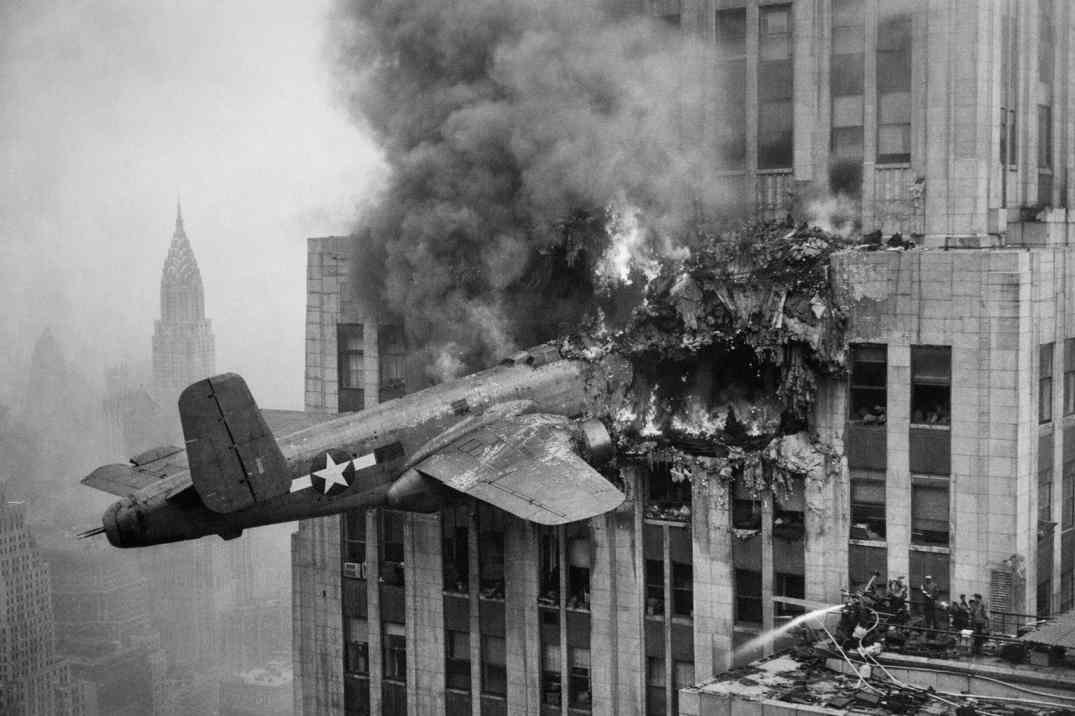
Photo of the Empire State Building on fire, distributed by International News Photos (Public domain).
Timeline: Empire State Building Plane Crash 1945
- Saturday, July 28, 1945 – 9:40 AM
B-25 bomber enters Manhattan airspace in heavy fog - Moments later
Aircraft crashes into the 79th floor - Minutes after impact
Fires spread; elevator cables snap - Same day
Emergency services contain the blaze - 48 hours later
Most offices reopen - Following months
Full repairs completed

B-25 Mitchell bomber used during World War II. Sherwood Mark, Public domain.
What Happened in the Empire State Building Plane Crash of 1945?
On July 28, 1945, a U.S. Army Air Forces B-25 Mitchell bomber
crashed into the Empire State Building during heavy fog.
- Time: 9:40 a.m.
- Location: 79th floor, north side
- Aircraft: B-25 Mitchell bomber
- Mission: Routine personnel transport from Massachusetts to New Jersey
The pilot, Lt. Col. William F. Smith Jr., became disoriented in poor visibility
and descended too low while flying over Manhattan.
Read also: Cold War from March 12, 1947 to December 26, 1991
Why Did the Plane Hit the Empire State Building?
Key causes of the accident:
- Dense fog reduced visibility to near zero
- Navigation error caused the aircraft to drift east instead of west
- Low-altitude flight over Manhattan skyscrapers
- No modern radar or collision-avoidance systems (this was 1945)
Air traffic controllers had warned the pilot about weather conditions, but the flight continued.
What to Do and See in NYC | Must-See Attractions and Hidden Gems
The Impact and Immediate Damage
The bomber struck the building at approximately 200 mph (≈ 322 km/hour).
Consequences:
- One engine passed entirely through the building and landed on a nearby rooftop
- Fuel ignited a massive fire across several floors
- Elevator cables snapped, sending an elevator car crashing downward
Despite the severity, the Empire State Building’s steel structure
held firm, proving its extraordinary engineering.

Bomber embedded in the Empire State Building after the 1945 crash. Acme Newspictures, Public domain.
Casualties and Human Cost
- 14 people killed
- 3 crew members
- 11 civilians inside the building
- Dozens injured, many severely burned
A remarkable survival story
Elevator operator Betty Lou Oliver survived a
75-floor fall when the elevator cables broke — one of the longest
survivable elevator falls ever recorded.
How Quickly Was the Building Repaired?
Most offices reopened within two days.
Full repairs were completed in just a few months.
This resilience became a powerful symbol of post-war American confidence.

Workmen clearing the wreckage. Acme Newspictures, Public domain, via Wikimedia Commons
Why Is the Empire State Building Plane Crash So Little Known?
- Occurred just days before World War II officially ended
- Media attention shifted to Hiroshima and Japan’s surrender
- No terrorism or sabotage, classified as an accident
- No lasting structural collapse
As a result, the story never became embedded in popular culture.
Did This Accident Change Aviation or Building Safety?
Yes, quietly but significantly.
- Stricter flight rules over dense urban areas
- Improved instrument-based navigation
- Reinforced confidence in steel-frame skyscraper design
- Influenced later high-rise fire safety planning
The Vanishing Skyjacker: The Mysterious Case of Dan Cooper, an Unsolved FBI Enigma
Frequently Asked Questions
Did a plane really crash into the Empire State Building?
Yes. A military bomber crashed into it in 1945.
How many people died?
Fourteen people.
Did the building almost collapse?
No. The structure remained intact.
Why don’t more people know about this event?
It was overshadowed by the end of World War II.
Final Takeaway
The Empire State Building plane crash of 1945 remains one of the most extraordinary, and forgotten events in New York City history. It revealed both the fragility of human navigation and the strength of modern engineering.
If this accident happened today, it would dominate world news for weeks.
In 1945, it became a historical footnote, but one worth remembering.
Sources: PinterPandai, Wikipedia, History.com, Military.com
Main photo powered by GPT