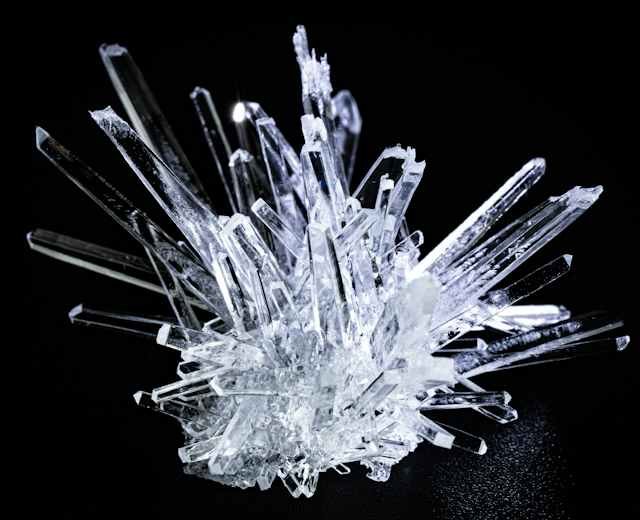
Cerium is the chemical element with symbol Ce and atomic number 58. It is a soft, grey lanthanide metal and the most abundant of the rare-earth elements in Earth’s crust. Cerium tarnishes rapidly in air and can ignite when finely divided.
Cerium quick facts
| Property | Value |
| Symbol | Ce |
| Atomic number | 58 |
| Relative atomic mass | 140.116 |
| Period | 6 |
| Block | f-block |
| Density | 6.77 g/cm³ |
| Melting point | 799°C |
| Boiling point | 3443°C |
| Electron configuration | [Xe] 4f¹ 5d¹ 6s² |
| Common oxidation states | +3, +4 |
| CAS number | 7440-45-1 |
| Key isotope | ¹⁴⁰Ce |
Chemistry and occurrence
Cerium is unusual among the lanthanides because both Ce³⁺ and Ce⁴⁺ are important. It occurs chiefly in monazite and bastnäsite and is separated from other rare earths through chemical extraction and ion-exchange processes.
See the complete CleverlySmart periodic table.
Important compounds and uses
- Cerium dioxide (CeO₂): used to polish glass, in catalytic converters, oxygen sensors and self-cleaning surfaces.
- Mischmetal: cerium-rich rare-earth alloys are used in lighter flints because they spark readily.
- Catalysts: cerium oxides store and release oxygen, improving emission-control and fuel-processing catalysts.
- Glass and lighting: cerium compounds absorb ultraviolet radiation and are used in specialty glass, lamps and optical products.
- Pigments and ceramics: cerium compounds can provide colour and improve material properties.
Cerium isotopes
Natural cerium consists mainly of ¹⁴⁰Ce and ¹⁴²Ce, with smaller amounts of ¹³⁶Ce and ¹³⁸Ce. Some are stable while others are extremely long-lived radioactive nuclides. See the CleverlySmart isotope table.
Biological role and safety
Cerium has no known essential biological role. Rare-earth dusts and fumes should be controlled in workplaces, and finely divided cerium metal can ignite.
Discovery and name
Cerium was discovered in 1803 by Jöns Jacob Berzelius and Wilhelm Hisinger in Sweden and independently by Martin Heinrich Klaproth in Germany. It was named after the asteroid Ceres.
Cerium key data
| Atomic number | 58 |
| Standard atomic weight | 140.116 |
| Electron configuration | [Xe] 4f¹ 5d¹ 6s² |
| Melting point | 799 °C (1,470 °F) |
| Boiling point | 3,443 °C (6,229 °F) |
| Density | 6.77 g/cm³ |
| Common oxidation states | +3 and +4 |
Cerium is a soft, grey-silvery lanthanide and one of the most abundant rare-earth elements in Earth’s crust. It tarnishes readily and is especially important because it can switch between the +3 and +4 oxidation states.
Chemistry: why ceria matters
The best-known cerium compound is cerium(IV) oxide, CeO₂, usually called ceria. Ceria can store and release oxygen under changing conditions, which makes it valuable in catalytic and polishing applications. Cerium(III) compounds are also common in rare-earth chemistry.
Major uses of cerium
- Vehicle catalytic converters: ceria helps manage oxygen availability and supports the conversion of exhaust pollutants.
- Glass polishing: cerium oxide is widely used as an abrasive for optical glass, mirrors and precision surfaces.
- Mischmetal and lighter flints: cerium is a major component of pyrophoric rare-earth alloys.
- Glass and ceramics: cerium compounds can modify color, UV absorption and other material properties.
Isotopes
Natural cerium contains four principal isotopes: Ce-136, Ce-138, Ce-140 and Ce-142. Ce-140 is by far the most abundant. For a broader explanation of stable and radioactive nuclides, see our complete isotope table guide.
Safety and handling
Cerium metal is reactive, especially when finely divided, and can oxidize or burn when heated. Safety depends on the exact form and compound, so laboratory and industrial work should follow the relevant safety data sheet rather than treating all cerium materials as equivalent.
Quick FAQ
What is ceria? Ceria is cerium(IV) oxide, CeO₂, an important polishing and catalyst material.
Why is cerium useful in catalysts? The Ce³⁺/Ce⁴⁺ redox pair allows ceria to store and release oxygen as conditions change.
Where is Ce on the periodic table? Cerium is element 58 in period 6 and belongs to the lanthanide series. Compare it with neighboring elements on our periodic table guide.