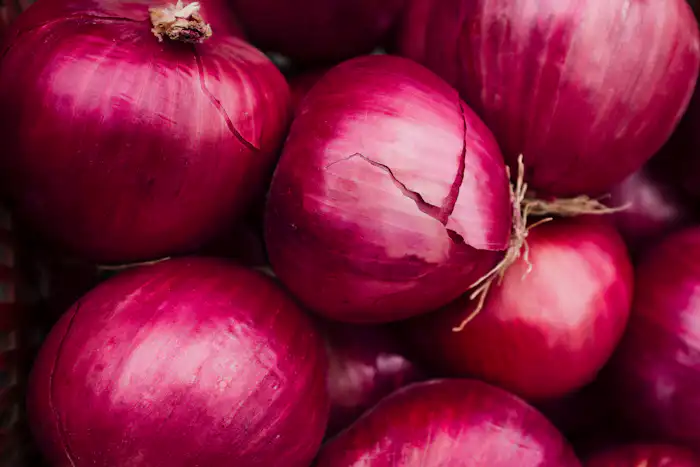
Short answer: why onions make you cry is a rapid enzyme-driven defense reaction. Cutting breaks onion cells and mixes sulfur-containing precursors with enzymes that were stored separately. The pathway produces volatile syn-propanethial-S-oxide. When this compound reaches the moist surface of the eye, sensory nerves trigger reflex tears to dilute and remove the irritant.
The onion does not spray sulfuric acid, and most people are not having an allergic reaction. The tearing is a normal protective response. Variety, storage, temperature, cutting technique, airflow, and individual sensitivity all influence how strong it feels.
The chemistry behind why onions make you cry
An intact onion keeps reactive ingredients apart inside its cells. A knife ruptures cell walls and membranes, allowing enzymes to meet flavor precursors. The chemistry unfolds in seconds:
- Cutting damages onion tissue.
- Alliinase acts on sulfur-containing cysteine sulfoxides.
- One branch forms 1-propenesulfenic acid.
- Lachrymatory factor synthase, or LFS, converts that intermediate into syn-propanethial-S-oxide.
- The small volatile compound escapes into the air.
- Contact with the eye activates sensory pathways and the lacrimal glands release reflex tears.
Researchers identified LFS as a dedicated enzyme rather than treating the tear factor as a simple spontaneous by-product. Later structural studies mapped how the enzyme supports this unusual reaction, while gene-silencing experiments showed that reducing LFS changes both tearing and the wider sulfur-metabolite profile.
Why does the eye respond with tears?
The cornea carries dense sensory innervation because the eye must react quickly to dust, smoke, and chemicals. When onion vapor irritates the ocular surface, the nervous system increases tear production. The fluid dissolves and dilutes the irritant, then spreads it toward the drainage system.
These are reflex tears, not emotional tears. Basal tears continuously lubricate and protect the eye, while emotional tears accompany strong feelings. The trigger differs, even though the same lacrimal system contributes fluid.
Onion sulfur chemistry also creates flavor
Onions, garlic, leeks, and related Allium plants use sulfur chemistry to build their characteristic aromas. Tissue damage releases several pathways at once. The lachrymatory factor is only one product; thiosulfinates and other compounds contribute pungency and develop into new aromas during resting or cooking.
| Preparation | Cell damage and enzyme activity | Likely sensory effect |
|---|---|---|
| Large slices | Moderate damage | Slower aroma release |
| Fine chopping or grating | Extensive damage | Faster, stronger pungency |
| Chilling | Slower reactions and evaporation | Potentially fewer tears |
| Cooking | Enzymes deactivate; volatile products change | Raw sharpness falls and cooked aromas grow |
This is a practical example of enzyme specificity. The broader lesson on how enzymes work explains why temperature, structure, and substrate contact matter.
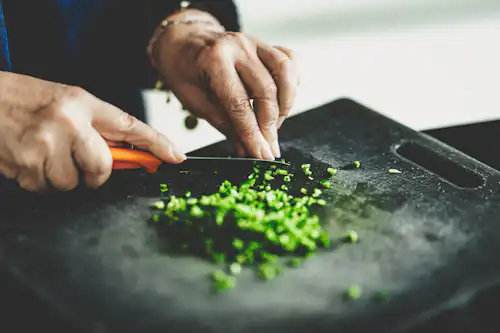
Methods that genuinely reduce onion tears
Use a sharp knife
A sharp blade makes cleaner cuts and usually crushes fewer cells than a dull one. Less crushing can release the reactants more gradually. Good knife control also matters more for safety than any kitchen trick.
Move air away from your face
A small fan or range hood can carry vapor away before it reaches the eyes. Point the airflow across the board and away from the cook. A fan blowing toward your face may make the problem worse.
Chill the onion
Refrigerating an onion before cutting can slow enzyme activity and reduce volatility. Cooling does not remove the precursors or LFS, so it cannot guarantee a tear-free experience. Freezing is unnecessary for routine preparation and may damage texture.
Wear sealed eye protection
Close-fitting kitchen or laboratory goggles create a physical barrier. Ordinary glasses leave open paths around the sides, so their effect is limited. Contact lenses are not a substitute for protective eyewear.
Prepare efficiently
Set out the board, knife, and container before starting. Keep your face back from the board, finish the cuts without long pauses, and move chopped onion into the pan or a covered container. Reducing exposure time lowers the dose that reaches the eyes.
Popular onion tricks: useful, weak, or unsafe?
Leaving the root end intact
The base is dense, and leaving it intact until late may reduce unnecessary cutting. However, the relevant precursors and enzymes occur throughout the bulb. The root is not a single storage tank for all tear-producing chemistry.
Cutting under water
Water can capture some volatile material, but a submerged onion and knife are slippery. The safety trade-off makes this a poor general recommendation. A wet board alone does not reliably intercept vapor moving toward the face.
Lighting a candle
A small flame cannot reliably draw in or destroy all the irritant before it reaches the cook. Adding an open flame near towels, packaging, or cooking oil creates an unnecessary hazard.
Chewing bread or sticking out the tongue
Neither method seals the eyes nor controls the plume at its source. Any benefit is more likely to come from changing head position or expectation than from neutralizing the molecule.
Why cooked onions usually stop making eyes water
Heat changes both the enzymes and their products. Proteins such as alliinase and LFS lose the shapes required for catalysis. Volatile compounds already present escape or undergo further reactions. Once the onion is cooking, the fresh-tissue pathway no longer runs in the same way.
Meanwhile, water evaporates, sugars become more concentrated, and browning chemistry produces new aromas. The Maillard reaction explains part of the savory complexity that develops during higher-temperature cooking. Food emulsions provide another kitchen example where molecular structure shapes texture and flavor.
Do all onions produce the same response?
No. Cultivar, soil sulfur, growing conditions, maturity, storage, and tissue condition affect flavor precursors. “Sweet onion” usually describes a milder balance of pungency and sweetness, not a total absence of lachrymatory chemistry.
Scientists have reduced LFS activity through gene silencing, breeding, and recent genome-editing research. Lower LFS can reduce the tear factor, but the sulfur pathway does not simply vanish. Metabolic flow shifts toward other compounds, which may alter flavor, aroma, and biological activity. The element-level background is covered in this guide to sulfur.
Common misconceptions
- “Onions make sulfuric acid in your eyes.” The recognized onion lachrymatory factor is syn-propanethial-S-oxide.
- “All the irritant is in the root.” Relevant enzymes and precursors occur across the bulb.
- “Tearing proves an onion allergy.” In most cases it is temporary chemical irritation and a reflex response.
- “The strongest-tasting onion must always cause the most tears.” Pungency and tear factor share a sulfur network, but they do not always rise in a simple fixed ratio.
A simple classroom investigation
With adult supervision and safe knife handling, compare equal portions of the same onion under three conditions: room temperature with still air, chilled with still air, and room temperature with a fan blowing away from the cutter. Keep cut size, knife, distance, and timing as similar as possible.
Use a rating scale from zero to five for eye irritation and record the time until symptoms begin. The experiment will not measure molecules directly, and personal expectations can bias ratings. Still, it demonstrates controlled variables and shows why several repeated trials are better than one dramatic experience.
Quick quiz with explanations
- What first allows the tear-producing pathway to begin?
Cell damage mixes enzymes with sulfur-containing precursors. - Which enzyme creates the lachrymatory factor?
Lachrymatory factor synthase, or LFS. - What is the main volatile tear factor called?
Syn-propanethial-S-oxide. - Why does the eye release tears?
Tears dilute and remove the detected irritant. - Why can a sharp knife help?
It tends to crush fewer cells than a dull blade. - Does keeping the root intact remove all tearing?
No. The pathway’s components occur throughout the onion. - Why does heating reduce the effect?
Heat deactivates the enzymes and changes volatile products. - Which method blocks exposure most directly?
Close-fitting eye protection.
Authoritative sources
- American Chemical Society: syn-Propanethial S-oxide
- ACS Chemical Biology: crystal structure of onion LFS
- Plant Physiology: LFS suppression and sulfur metabolites
Conclusion
Onions make eyes water because cutting breaks cells and activates an enzyme pathway that produces a volatile sulfur compound. The eyes detect that irritant and answer with protective reflex tears. A sharp knife, chilling, outward airflow, efficient preparation, and sealed goggles work by reducing production, exposure, or contact—clearer mechanisms than most kitchen myths.
For an Indonesian companion lesson with a different comparison table and myth review, read Mengapa Bawang Membuat Mata Berair? Kimia di Balik Air Mata.