Short answer: why glass is transparent comes down mainly to energy. Photons of visible light usually do not have the right energy to trigger strong electronic absorption in clear glass, so much of that light travels through. Glass still reflects, refracts, scatters, and absorbs some light; transparency is transmission with limited loss, not an absence of interaction.
A popular explanation says glass is clear because its atoms are disordered. That statement is incomplete. Some amorphous materials are opaque, while pure single crystals can be beautifully transparent. Electronic energy levels, composition, defects, thickness, surface condition, and wavelength all matter.
Why glass is transparent to visible light
Light arrives in packets called photons. A photon’s energy is:
E = hc/λ
Here, E is photon energy, h is Planck’s constant, c is the speed of light in vacuum, and λ is wavelength. Shorter-wavelength photons carry more energy.
Electrons in a solid cannot absorb arbitrary amounts of energy. They occupy allowed states separated from other states by energy ranges. In many silicate glasses, the gap between occupied electronic states and available higher states is too wide for most visible photons to bridge. With no efficient transition available, visible light avoids strong absorption and can propagate through the material.
Penn State’s materials course and MIT solid-state chemistry lessons describe this behavior with energy bands and a band gap. This model also explains why a glass can be clear in the visible range yet block much of the ultraviolet or absorb selected infrared wavelengths.
Transmission is only part of the story
| Process | What happens | Visible result |
|---|---|---|
| Transmission | Light propagates through the glass | Objects remain visible behind it |
| Reflection | Light returns from an interface | Glare or a faint mirror image |
| Refraction | Direction and phase velocity change | Apparent displacement or bending |
| Absorption | Photon energy transfers to the material | Reduced intensity or selective color |
| Scattering | Light spreads into many directions | Haze, translucency, or opacity |
Why a clean window still reflects
At normal incidence, the reflected fraction at a simple interface can be estimated by:
R ≈ ((n1 − n2) / (n1 + n2))²
For air with refractive index near 1 and ordinary glass near 1.5, the estimate is roughly 4% at one surface. A pane has two main surfaces, and real values depend on wavelength, angle, polarization, composition, and coatings. This is why a window can transmit a scene while also showing your reflection.
Why light slows and bends
The refractive index satisfies n = c/v, where v is the phase velocity in the material. The electromagnetic field drives bound charges in the glass, and their collective response shifts the wave’s phase. Saying that photons repeatedly stop and restart at each atom is a misleading shortcut.
Dispersion: why a prism separates colors
A glass refractive index changes slightly with wavelength. Blue and violet light usually experience a different index from red light, so a prism bends the colors by different amounts. This wavelength dependence is dispersion.
A flat window has parallel surfaces, so the second refraction largely restores the original direction even though the beam shifts sideways. A prism uses nonparallel surfaces, allowing the angular differences between wavelengths to spread into a rainbow.
Why some glass is colored, cloudy, or opaque
Added ions create new absorption paths
Transition-metal ions and other additives can introduce electronic transitions within the visible range. Cobalt compounds can produce blue glass; iron can contribute green, brown, or amber tones depending on chemistry and oxidation state. Stained glass deliberately turns selective absorption into art.
Bubbles, crystals, and roughness scatter light
Light changes direction when it meets regions with different refractive indices. Pores, inclusions, tiny crystals, or surface texture can scatter many rays. If enough scattering occurs, the material looks milky or opaque even when its chemical ingredients do not strongly absorb visible light.
Longer paths reveal weak absorption
A thin sample may look colorless while a thick edge looks green or gray. Weak absorption accumulates as light travels farther through the glass. The Beer–Lambert relationship captures this principle by connecting transmitted intensity with absorption coefficient and path length.
Glass is not transparent at every wavelength
“Transparent” must always name a spectral range. Ordinary soda-lime window glass transmits much of the visible spectrum, blocks substantial ultraviolet, and absorbs parts of the infrared. Fused silica, chalcogenide glass, and other specialty compositions serve different wavelength ranges.
Optical-fiber glass requires exceptional purity because even small losses matter across kilometers. Thermal-imaging systems need materials that transmit the relevant infrared bands. A household window balances visibility with cost, strength, weather resistance, manufacturing, and building performance rather than universal optical transmission.
Is disorder the reason glass is clear?
Glass lacks the long-range periodic order of a crystal, and that amorphous uniformity can reduce scattering from grain boundaries. Still, disorder alone does not guarantee transparency. An amorphous solid with suitable absorption states can be dark, while a pure single crystal with a wide band gap can be clear.
The better rule is this: a transparent material needs low absorption and low scattering in the wavelength range of interest. Electronic structure controls much of the absorption; chemical and physical uniformity control much of the scattering.
Four observations you can make safely
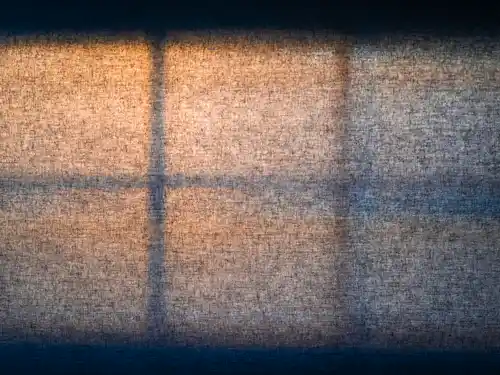
- Look at a window from a bright room toward a dark exterior, then reverse the lighting. The stronger reflection appears on the darker-background side.
- Place a pencil in a clear glass of water. Its apparent bend demonstrates refraction at interfaces.
- Compare one glass sheet with a stack viewed through the edges. Thickness makes weak color and loss easier to see.
- Use a prism or safe diffraction device to examine a lamp’s spectrum. Never focus sunlight toward eyes, skin, or flammable objects.
These observations separate four ideas that people often merge. A material can transmit and reflect simultaneously. It can be transparent yet refract strongly. It can pass light without preserving a sharp image if scattering becomes large.
Common misconceptions
“Glass does nothing to visible light”
Glass polarizes in response to the electromagnetic field, changes phase velocity, reflects at interfaces, and may absorb or scatter a fraction of the beam.
“Old windows prove glass flows at room temperature”
Window glass is an amorphous solid under ordinary conditions. Uneven historical panes mainly reflect older manufacturing methods, not visible gravitational flow over centuries.
“Transparent materials have large gaps between atoms”
Atomic spacing is not the key. Light interacts with collective electronic states and material structure. Dense solids can be transparent when accessible absorption and scattering channels are absent.
“Clear means invisible”
Surface reflections, dust, scratches, edges, refraction, and background contrast reveal even excellent glass. Antireflection coatings can reduce reflection, but they do not make every loss disappear.
Connections to other physics lessons
The article on photons develops the quantum picture of light. Glass memory technology shows how optical properties support data storage. Atmospheric examples such as light pillars and the aurora extend the study of emission, scattering, and color.
Quick quiz with explanations
- Why does clear glass absorb relatively little visible light?
Most visible photons cannot access strong electronic transitions in the glass. - Does a transparent pane transmit all incoming light?
No. It also reflects, absorbs, and scatters a fraction. - What does n = c/v describe?
It relates refractive index to the phase velocity of light in a material. - Why does a prism make a rainbow?
The refractive index varies with wavelength, so colors bend by different angles. - How can additives color glass?
They introduce absorption transitions that remove selected visible wavelengths. - Why can frosted glass pass light without a clear image?
Its surface scatters rays into many directions. - Is every amorphous solid transparent?
No. Absorption states and optical inhomogeneity can make an amorphous material opaque. - Why can a thick glass edge look darker than a thin pane?
A longer path accumulates more weak absorption and scattering.
Authoritative sources
- Penn State: Why Is Glass Transparent?
- MIT OpenCourseWare: glass and electronic structure
- University of Illinois: optical principles of glass and ceramics
Conclusion
Glass is transparent in the visible range because its electronic structure leaves few efficient ways to absorb visible photons, while a clean, uniform structure limits scattering. The same pane still reflects and refracts light, and its behavior changes with wavelength, composition, defects, and thickness. Transparency is therefore a carefully bounded optical property, not a claim that glass and light ignore each other.
For a companion explanation in Indonesian with different classroom observations, read Mengapa Kaca Transparan? Cara Cahaya Menembus Kaca.