Vanadium is the chemical element with symbol V and atomic number 23. It is a hard, silvery-grey transition metal best known for strengthening steel and for forming colourful compounds in several oxidation states.
Vanadium quick facts
| Property | Value |
| Symbol | V |
| Atomic number | 23 |
| Relative atomic mass | 50.942 |
| Group | 5 |
| Period | 4 |
| Block | d-block |
| State at 20°C | Solid |
| Density | About 6.0 g/cm³ |
| Melting point | 1910°C |
| Boiling point | About 3407°C |
| Electron configuration | [Ar] 3d³ 4s² |
| Common oxidation states | +2, +3, +4, +5 |
| CAS number | 7440-62-2 |
| Main natural isotope | ⁵¹V |
Position and electron configuration
Vanadium is in group 5, period 4 and the d-block. Its ground-state electron configuration is [Ar] 3d³ 4s². Vanadium chemistry is notable for several accessible oxidation states, especially +2, +3, +4 and +5.
See the complete CleverlySmart periodic table.
Physical and chemical properties
Pure vanadium is hard, ductile and corrosion-resistant because an oxide film forms on its surface. The metal has a high melting point and good structural strength. Vanadium compounds show striking colours because different oxidation states have different electronic structures.
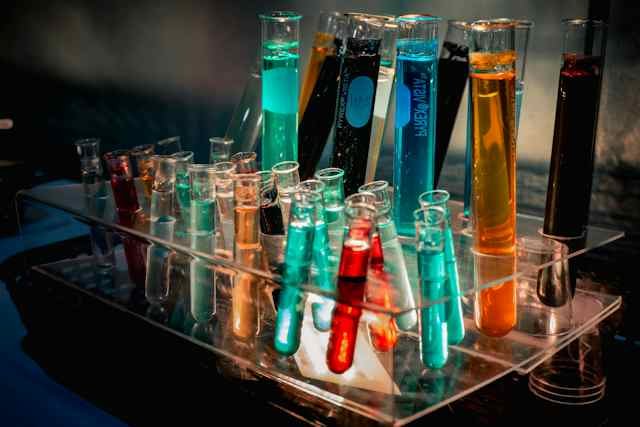
In aqueous chemistry, vanadium species can range from violet V(II) and green V(III) to blue V(IV) and yellow-orange V(V), making vanadium a classic example of transition-metal redox chemistry.
Occurrence and production
Vanadium occurs in many minerals and can also be associated with iron ores, phosphate rocks, petroleum residues and certain uranium ores. Much commercial vanadium is recovered as a co-product rather than from ores mined solely for vanadium.
Important vanadium compounds
- Vanadium pentoxide (V₂O₅): the most important industrial vanadium oxide, used as a catalyst and as a starting material for other vanadium compounds.
- Vanadyl sulfate: contains vanadium(IV) and is common in laboratory chemistry and research.
- Vanadates: salts containing vanadium in high oxidation states, important in inorganic chemistry and materials science.
Uses of vanadium
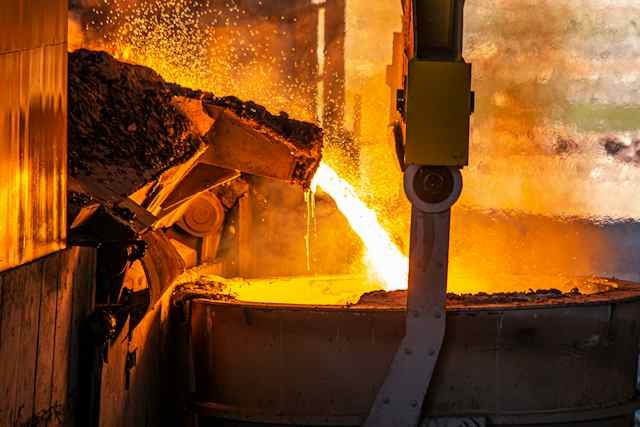
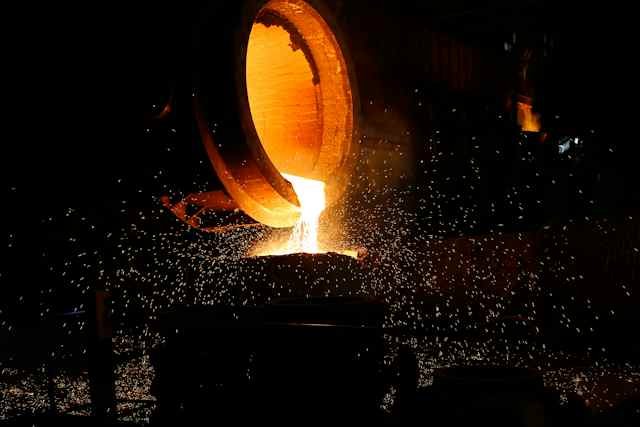
- Steel alloys: the largest use of vanadium. Small additions improve strength, hardness, wear resistance and toughness.
- Tool and high-strength steels: vanadium carbides help control grain size and improve performance.
- Titanium alloys: vanadium is an important alloying element in widely used aerospace titanium alloys.
- Catalysts: V₂O₅ is used in sulfuric-acid production and other oxidation reactions.
- Vanadium redox-flow batteries: use vanadium ions in different oxidation states to store electrical energy in liquid electrolytes.
Vanadium isotopes
Natural vanadium consists mostly of ⁵¹V, which is stable, together with a very small amount of long-lived radioactive ⁵⁰V. Numerous other radioisotopes are produced artificially for research.
For broader isotope information, see the CleverlySmart isotope table.
Biological role and safety
Vanadium is used by some organisms and enzymes, but no universally accepted essential nutritional role has been established for humans. Vanadium compounds vary greatly in toxicity; dusts and soluble compounds should be handled with occupational controls. Vanadium pentoxide can irritate the respiratory system.
Discovery and name
Andrés Manuel del Río discovered vanadium in Mexico in 1801 but was persuaded that his sample represented chromium. The element was rediscovered in 1830–1831 by Nils Gabriel Sefström. The name comes from Vanadis, a name associated with the Norse goddess Freyja, referring to the colourful nature of vanadium compounds.
Frequently asked questions
What is vanadium mainly used for?
Most vanadium is used as an alloying element to strengthen steel.
Why does vanadium have many colours?
Different oxidation states change the arrangement and energy of d electrons, so vanadium ions absorb different wavelengths of visible light.
Vanadium in alloys and energy storage
Vanadium is especially useful because small additions can strengthen steels without a large weight penalty. Vanadium carbides and nitrides refine grain size and improve wear resistance, which is valuable in tools, springs, pipelines and high-strength structural steels.
Vanadium can also adopt several oxidation states, commonly +2, +3, +4 and +5. Their ions have distinctive colours, making vanadium a classic example of transition-metal redox chemistry.
Vanadium redox-flow batteries
Large stationary energy-storage systems can use vanadium ions dissolved in separate electrolyte tanks. Because both half-cells use vanadium in different oxidation states, cross-contamination is easier to manage than in many mixed-element battery chemistries. The systems are attractive for long-duration storage, although cost and energy density remain important constraints.
Frequently asked questions
Why are vanadium compounds colourful?
Different oxidation states change the electronic structure of the vanadium ion, so they absorb different wavelengths of visible light.
Does vanadium have a biological role?
Trace biological roles occur in some organisms, including certain enzymes, but vanadium is not established as an essential nutrient for humans.