Titanium is the chemical element with symbol Ti and atomic number 22. It is a strong, lightweight, corrosion-resistant transition metal that combines a high strength-to-weight ratio with excellent resistance to seawater and many chemicals.
Titanium quick facts
| Property | Value |
| Symbol | Ti |
| Atomic number | 22 |
| Relative atomic mass | 47.867 |
| Group | 4 |
| Period | 4 |
| Block | d-block |
| Density | 4.506 g/cm³ |
| Melting point | 1668°C |
| Boiling point | 3287°C |
| Electron configuration | [Ar] 3d² 4s² |
| Common oxidation states | +4, +3 |
| CAS number | 7440-32-6 |
| Stable natural isotopes | ⁴⁶Ti, ⁴⁷Ti, ⁴⁸Ti, ⁴⁹Ti, ⁵⁰Ti |
Position and electron configuration
Titanium is in group 4, period 4 and the d-block. Its electron configuration is [Ar] 3d² 4s². The +4 oxidation state dominates much of titanium chemistry, while +3 is also common.
See the complete CleverlySmart periodic table for all elements.
Physical and corrosion properties
Titanium is a lustrous silver-grey metal. It is much less dense than steel but can achieve high mechanical strength when alloyed. Its excellent corrosion resistance comes from a thin, tightly adhering surface film of titanium dioxide that rapidly forms in air or water.
Titanium also retains useful strength at elevated temperature and is non-ferromagnetic. These properties make it valuable where weight, corrosion resistance and reliability matter simultaneously.
Important titanium compounds
- Titanium dioxide (TiO₂): an intensely white, chemically stable pigment used in paints, coatings, plastics, paper, cosmetics and many other products.
- Titanium tetrachloride (TiCl₄): a volatile liquid used as an intermediate in titanium-metal production and TiO₂ manufacture.
- Titanium nitride (TiN): a hard, wear-resistant ceramic coating with a characteristic gold colour.
- Titanium carbide (TiC): a very hard refractory material used in cutting and wear-resistant applications.
How titanium is produced
Titanium occurs mainly in minerals such as rutile and ilmenite. Producing metallic titanium is more difficult than producing common structural metals because hot titanium reacts readily with oxygen, nitrogen and carbon.
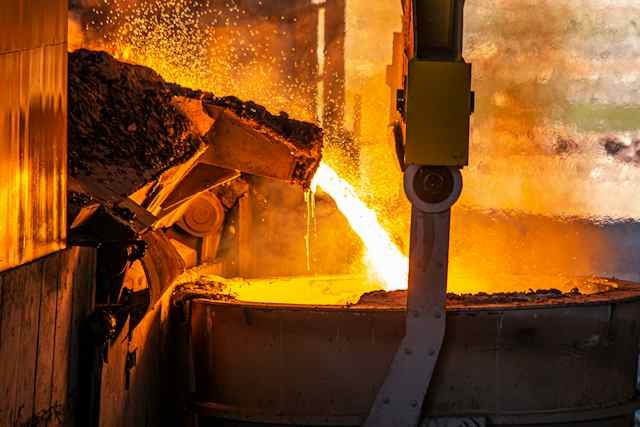
In the widely used Kroll process, titanium ore is converted to titanium tetrachloride, purified, and then reduced with magnesium to produce porous titanium metal known as sponge. The sponge is melted and alloyed under carefully controlled conditions.
Uses of titanium
- Aerospace: airframes, jet-engine components and spacecraft structures use titanium alloys for high strength at low weight.
- Medical implants: titanium and certain alloys are used in bone screws, joint replacements, dental implants and other devices because of their biocompatibility and corrosion resistance.
- Chemical and marine equipment: heat exchangers, piping and vessels benefit from resistance to seawater and many corrosive environments.
- Pigments: TiO₂ is one of the world’s most important white pigments.
- High-performance products: bicycles, sporting goods and specialised fasteners may use titanium where weight and durability justify the cost.
Titanium isotopes
Natural titanium contains five stable isotopes: ⁴⁶Ti, ⁴⁷Ti, ⁴⁸Ti, ⁴⁹Ti and ⁵⁰Ti. Titanium-48 is the most abundant. Radioisotopes such as titanium-44 are important in nuclear and astrophysical research.
See the CleverlySmart isotope table for wider isotope information.
Biological role and safety
Titanium has no known essential biological role. Bulk titanium metal is generally valued for good biocompatibility, but titanium dust and fine powders can present fire or explosion hazards. Chemical safety depends strongly on the specific compound: for example, titanium tetrachloride reacts violently with moisture and produces corrosive fumes.
Discovery and name
Titanium was identified in 1791 by William Gregor in Cornwall. A few years later Martin Heinrich Klaproth independently recognised the element and named it after the Titans of Greek mythology.
Frequently asked questions
Why is titanium so corrosion-resistant?
Because it rapidly forms a stable, adherent titanium-oxide film that protects the underlying metal.
Is titanium stronger than steel?
Strength depends on the specific alloy and heat treatment. Titanium alloys are especially valued for high strength relative to their low density, not because every titanium alloy is stronger than every steel.
Crystal phases and high-performance alloys
Titanium changes crystal structure with temperature. At ordinary temperatures it has the hexagonal close-packed alpha phase; above about 882°C it transforms to the body-centred cubic beta phase. Alloying elements can stabilise one phase or the other, allowing engineers to tune strength, toughness and high-temperature performance.
The best-known aerospace alloy is Ti-6Al-4V, valued for its high strength-to-weight ratio and fatigue resistance. Titanium is also biocompatible and forms a stable oxide surface, so it is widely used for orthopaedic implants, dental implants and surgical hardware.
Titanium dioxide and corrosion resistance
Titanium dioxide (TiO₂) is produced on a far larger scale than titanium metal. It is an important white pigment in paints, plastics, paper and coatings. Titanium metal resists seawater and many chemicals because a thin TiO₂ film forms rapidly on its surface and can reform after minor damage.
Frequently asked questions
Is titanium stronger than steel?
Some titanium alloys approach high-strength steels in strength while being much lighter, so titanium often has a superior strength-to-weight ratio rather than simply greater absolute strength.
Why is titanium expensive?
Its ores are common, but converting them into clean metal requires energy-intensive refining such as the Kroll process and careful control of oxygen and nitrogen contamination.