Cobalt is the chemical element with symbol Co and atomic number 27. It is a hard, lustrous, silvery-blue transition metal notable for magnetism, high-temperature strength and intensely coloured compounds.
Cobalt quick facts
| Property | Value |
| Symbol | Co |
| Atomic number | 27 |
| Relative atomic mass | 58.933 |
| Group | 9 |
| Period | 4 |
| Block | d-block |
| Density | 8.86 g/cm³ |
| Melting point | 1495°C |
| Boiling point | 2927°C |
| Electron configuration | [Ar] 3d⁷ 4s² |
| Common oxidation states | +2, +3 |
| CAS number | 7440-48-4 |
| Stable natural isotope | ⁵⁹Co |
Position and electron configuration
Cobalt is in group 9, period 4 and the d-block. Its electron configuration is [Ar] 3d⁷ 4s². Cobalt commonly forms +2 and +3 compounds, many of which are strongly coloured and important in coordination chemistry.
See the complete CleverlySmart periodic table.
Physical and magnetic properties
Cobalt is one of the few elements that are ferromagnetic near room temperature, together with iron and nickel. It retains useful magnetic properties at relatively high temperatures and has good wear resistance and high-temperature strength when alloyed.
Important cobalt compounds
- Cobalt(II) oxide (CoO) and cobalt(II,III) oxide (Co₃O₄): used in ceramics, catalysts and battery-related materials.
- Cobalt chloride: used in laboratory chemistry and historically in humidity-indicating systems, though toxicity requires caution.
- Cobalt aluminate: the basis of the famous cobalt-blue pigment used in glass, ceramics and art.
- Lithium cobalt oxide (LiCoO₂): a major cathode material in many rechargeable lithium-ion batteries.
Occurrence and production
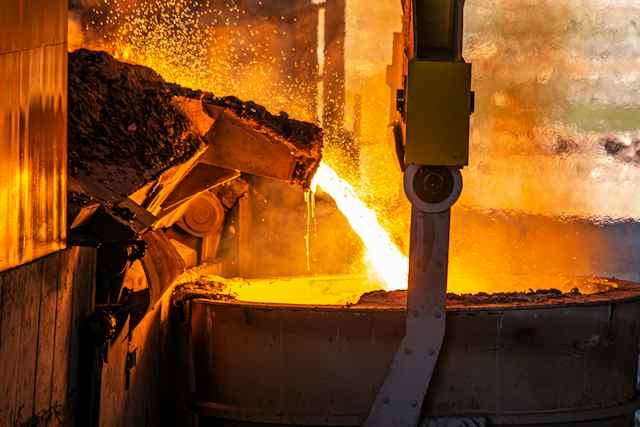
Cobalt is usually not mined as a pure cobalt ore. It is commonly recovered as a co-product of copper and nickel mining and refining. Separation can be chemically complex because cobalt often occurs together with several transition metals.
Uses of cobalt
- Superalloys: cobalt-containing alloys retain strength and corrosion resistance at high temperatures and are used in turbine and aerospace components.
- Rechargeable batteries: cobalt is used in several lithium-ion cathode chemistries.
- Magnets: samarium-cobalt and Alnico magnets use cobalt for strong and temperature-stable magnetic performance.
- Hard-facing and wear-resistant alloys: used for cutting, drilling, valves and demanding industrial surfaces.
- Pigments: cobalt compounds produce durable blue colours in glass, ceramics and paints.
Biological role: vitamin B12
Cobalt has an essential biological role because it sits at the centre of vitamin B12 (cobalamin). Humans require vitamin B12, but this does not mean that free cobalt salts should be consumed as supplements without medical justification. The biological form and dose matter greatly.
Cobalt isotopes
Natural cobalt consists essentially of one stable isotope, ⁵⁹Co. The radioactive isotope ⁶⁰Co is an intense gamma-ray source used in sterilisation, industrial radiography, research and some radiotherapy applications.
See the CleverlySmart isotope table for a broader nuclear reference.
Health and safety
Cobalt metal dust and soluble cobalt compounds can cause occupational health effects, including respiratory and skin sensitisation. Chronic excessive cobalt exposure can affect several organs. Radioactive cobalt requires specialised radiation controls.
History and name
Cobalt compounds were used for blue glass and ceramics long before the metal was isolated. Swedish chemist Georg Brandt identified cobalt as a distinct element in the 18th century. The name comes from the German Kobold, meaning goblin, reflecting miners’ frustration with troublesome cobalt-bearing ores.
Frequently asked questions
Why is cobalt used in batteries?
Cobalt-containing cathodes can provide useful combinations of energy density, voltage and structural stability, although battery chemistries increasingly aim to reduce cobalt use for cost and supply reasons.
Is cobalt magnetic?
Yes. Cobalt is ferromagnetic and is used in several important permanent-magnet alloys.
Cobalt in superalloys, magnets and batteries
Cobalt retains useful strength at high temperature and is therefore important in nickel- and cobalt-based superalloys used in turbine blades, jet engines and other severe environments. Cobalt is also used in hard-facing alloys and in powerful permanent magnets such as samarium–cobalt magnets.
Several lithium-ion battery cathodes contain cobalt because it helps stabilise layered crystal structures and supports high energy density. Manufacturers are also developing lower-cobalt and cobalt-free chemistries to reduce cost and supply-chain pressure.
Biology, radioisotopes and safety
Cobalt is an essential trace element because it sits at the centre of vitamin B₁₂. In contrast, excessive occupational exposure to cobalt dust or soluble compounds can affect the lungs and other organs.
Cobalt-60 is a strong gamma emitter produced in nuclear reactors. It is used in radiotherapy, industrial radiography and sterilisation, but requires strict radiation protection.
Frequently asked questions
Why is cobalt important in jet engines?
Cobalt-containing alloys can retain mechanical strength and resist oxidation at temperatures where many ordinary metals soften or corrode rapidly.
Is cobalt always magnetic?
Metallic cobalt is ferromagnetic below its Curie temperature, but cobalt compounds can have very different magnetic behaviour.