Psychic Prophecy: Meaning, History, Scientific Evidence and Is It Real?
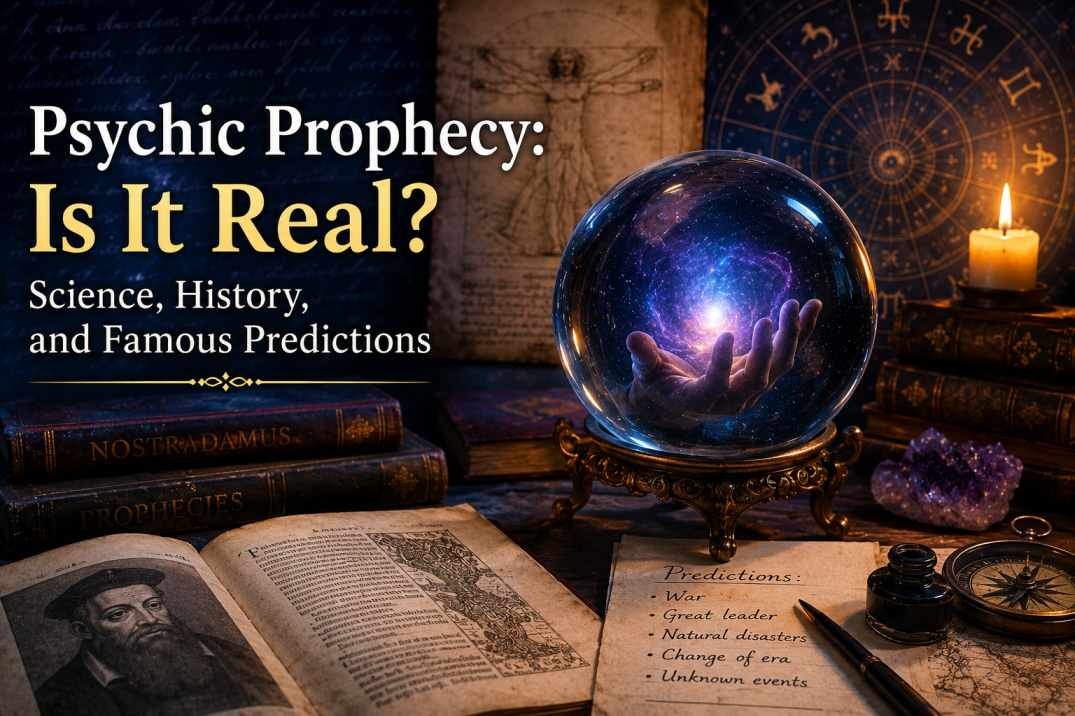
Stories about people seeing the future have appeared in religion, mythology and popular culture for thousands of years. Some people interpret an unusually accurate dream, a sudden feeling or a powerful vision as evidence of psychic ability. Others explain such experiences through intuition, coincidence, unconscious pattern recognition or selective memory.
So, can a psychic really predict what will happen? This article examines what psychic prophecy means, how it differs from religious prophecy and ordinary intuition, its historical background, famous examples and what scientific research has—and has not—established.
What Is Psychic Prophecy?
Psychic prophecy refers to a prediction or apparent revelation about the future that is believed to come from a psychic source rather than from ordinary analysis, observable evidence or a recognized scientific forecasting method.
A person claiming this ability may describe receiving information through:
- mental images or visions;
- dreams that appear to anticipate later events;
- a strong unexplained feeling or “inner knowing”;
- voices, symbols or impressions;
- contact with spirits or another supernatural source;
- tools such as tarot cards, astrology or crystal gazing.
The expression psychic prophecy is commonly used in popular culture, but it is not a precise scientific category. Researchers studying alleged anomalous perception are more likely to use terms such as precognition, extrasensory perception, anomalous cognition or psi.
Prophecy, Psychic Readings, Intuition and Precognition: What Is the Difference?
These terms are often used interchangeably, but they do not mean exactly the same thing.
| Term | Basic meaning | Claimed source | Must concern the future? |
|---|---|---|---|
| Prophecy | A message believed to be revealed by a divine or sacred source, sometimes delivered by a religious prophet. | God, revelation or divine inspiration | No. A prophecy may also contain warnings, teachings or moral instructions. |
| Psychic prophecy | A claimed prediction of future events obtained through paranormal perception. | Psychic impressions, visions, dreams, spirits or ESP | Usually yes |
| Psychic reading | A consultation in which a practitioner claims to provide information about a person’s life, relationships, personality or future. | Clairvoyance, cards, astrology, mediumship or intuition | No |
| Intuition | A rapid judgment or feeling that occurs without conscious step-by-step reasoning. | Often explained psychologically through experience, unconscious processing and pattern recognition | No |
| Precognition | The claimed acquisition of information about an event before it occurs, without using ordinary predictive clues. | Alleged extrasensory perception | Yes |
| Prediction | Any statement about what is expected to happen, whether based on data, probability, experience, belief or guessing. | Evidence, models, reasoning, belief or chance | Yes |
Prophecy Is Not Always a Prediction
In religious traditions, a prophet is not simply a fortune-teller. Prophecy may involve communicating a divine message, calling people to change their behaviour or explaining the spiritual meaning of events. Some prophecies concern the future, but future prediction is not necessarily their only—or even their main—purpose.
Intuition Is Not Necessarily Paranormal
Intuition can feel mysterious because the reasoning behind it is not always consciously available. However, psychologists often explain intuitive judgments as rapid processing based on previous experience and subtle environmental clues.
A nurse, firefighter, investor or parent may sense that something is wrong without immediately being able to identify every signal that produced the feeling.
Intuition can sometimes be useful, especially when it develops from substantial experience in a predictable environment. It can also be wrong, particularly when fear, stereotypes, wishful thinking or incomplete information influence judgment.
History of Psychic Prophecy
Attempts to understand or anticipate the future are much older than the modern word psychic. Ancient societies used dreams, oracles, omens, astrology, sacred rituals and interpretations of natural events to seek guidance.
Ancient Greece and the Oracle of Delphi
In ancient Greece, people visited sanctuaries to consult oracles on matters such as war, politics, travel and personal decisions. The Oracle of Delphi became one of the most famous. A priestess known as the Pythia delivered statements believed to come from the god Apollo.
These responses were often interpreted by priests or listeners. Historical accounts of the oracle have contributed to modern discussions about ambiguous predictions: language that is symbolic or open to several meanings can appear correct under different outcomes.
Ancient Egypt
Ancient Egyptian religion placed considerable importance on dreams, omens, priestly interpretation and communication with the divine. Some surviving texts classified dreams and associated particular dream images with favourable or unfavourable outcomes.
These practices should be understood in their historical and religious context.
They were not the same as a modern laboratory test of precognition, even though contemporary writers sometimes describe them using words such as psychic or paranormal.
Biblical Prophets
The Bible includes prophets such as Isaiah, Jeremiah, Ezekiel, Daniel and others.
Within the biblical tradition, prophets are presented primarily as messengers of God. Their roles may include warning communities, criticizing injustice, calling for repentance and communicating divine promises or judgments.
For that reason, biblical prophecy should not automatically be treated as equivalent to commercial fortune-telling or a modern psychic reading. The theological concept is based on divine revelation, whereas psychic prophecy is usually described as an individual paranormal ability.
Nostradamus
Michel de Nostredame, known as Nostradamus, was a 16th-century French astrologer and physician. He is best known for Les Prophéties, a collection of poetic four-line verses called quatrains.
Supporters have connected some quatrains to later wars, disasters, rulers and political events. Critics argue that many of these connections are made only after an event has occurred. The verses are often symbolic, translated in different ways and lacking precise dates, which allows readers to match them to many possible events.
Edgar Cayce
Edgar Cayce, an American figure active during the late 19th and early 20th centuries, became known for giving “readings” while apparently in a sleep-like trance. These readings covered health, reincarnation, spiritual topics and alleged future events.
Cayce’s followers regard him as an important clairvoyant. Skeptics note that his record contains disputed interpretations and unsuccessful predictions, and that anecdotes collected by admirers are not equivalent to controlled scientific evidence.
How Is Psychic Prophecy Supposed to Work?
There is no scientifically established mechanism showing how psychic prophecy would operate. Practitioners and spiritual traditions nevertheless propose several explanations. These ideas should be understood as claims or beliefs, not as demonstrated facts.
1. Clairvoyance
Clairvoyance literally refers to “clear seeing.” A clairvoyant may claim to receive visual impressions about a distant person, hidden object, past event or possible future. These impressions may be described as pictures, colours, symbols or scenes appearing in the mind.
Under scientific testing, however, reliable clairvoyant information would need to be obtained repeatedly while ordinary sensory information, prompting and accidental clues are carefully excluded.
2. Precognition
Precognition is the alleged ability to know something about a future event before it happens, without deriving the information from known facts or probability. Examples may include a supposedly predictive dream or a sudden image of an event that later occurs.
The central scientific difficulty is distinguishing genuine precognition from coincidence, vague resemblance, incorrect memory, unnoticed clues and retrospective interpretation.
3. Extrasensory Perception
Extrasensory perception, usually abbreviated as ESP, is an umbrella term for claimed information acquisition
without the ordinary senses. It traditionally includes:
- Telepathy: alleged mind-to-mind communication;
- Clairvoyance: alleged perception of distant or hidden information;
- Precognition: alleged perception of future information.
Researchers who investigate these claims sometimes use the broader term psi. The existence and interpretation of psi effects remain controversial.
4. Spiritual Communication
Some mediums believe that predictions are communicated by spirits, deceased individuals, guides, angels or divine beings. Such claims belong mainly to spiritual or religious belief systems.
Scientific investigation cannot simply assume that a message came from a spirit. Researchers first have to examine whether the information could have come from prior knowledge, observation, suggestion, general statements, ordinary inference or information obtained by other means.
5. Intuition
Some experiences described as psychic may be forms of intuition. The human brain continuously processes facial expressions, tone of voice, past behaviour and environmental patterns. A conclusion can reach conscious awareness before the person can explain how it was formed.
For example, someone may predict that a business partnership will fail because they unconsciously noticed inconsistent statements, tension and previous warning signs. The prediction may feel supernatural even though it developed from subtle but ordinary information.
Can Ordinary People Develop Psychic Prophecy?
Many spiritual teachers and psychic-development courses claim that everyone has some degree of psychic ability. Scientific research has not established that ordinary people can train themselves to predict future events reliably through paranormal means.
People can, however, improve several ordinary abilities that are sometimes confused with psychic powers:
- attention to subtle details;
- emotional awareness;
- memory for dreams and impressions;
- recognition of familiar patterns;
- critical thinking;
- probabilistic reasoning;
- awareness of personal bias.
Exercises for Exploring Intuition Responsibly
The following exercises may help a person study their own intuition. They should not be presented as proven methods for acquiring supernatural powers.
Keep a Time-Stamped Prediction Journal
Write every prediction before the outcome is known. Include:
- the exact prediction;
- the date and time;
- a deadline for the predicted event;
- the degree of confidence;
- the criteria that would make it correct or incorrect.
Record all predictions, including the failures. Counting only successful guesses creates a misleading impression of accuracy.
Practise Mindfulness
Mindfulness can improve awareness of thoughts, sensations and surroundings. It may help a person separate a calm observation from a fear-driven reaction. This does not demonstrate precognition, but it may improve attention and emotional self-regulation.
Keep a Dream Journal
Record dreams immediately after waking, before later events can alter the memory. Avoid rewriting the dream after something similar occurs. Compare the original wording with the event and ask whether the match is specific or only general.
Use Blind Tests
A simple blind test prevents the participant from seeing clues that could influence an answer. For example, another person can randomly choose one image from a predetermined set while the participant records a guess without seeing the choice.
Conduct many trials and define the scoring rules in advance. A few correct guesses are expected by chance, particularly when there are only a small number of choices.
Compare Intuition With Evidence
When a strong feeling occurs, write down the feeling and the observable evidence separately. This exercise can reveal whether the judgment was based on subtle information, emotion, previous experience or an unsupported assumption.
What Does Scientific Research Say About Psychic Prophecy?
Scientific interest in telepathy, clairvoyance and precognition has existed for more than a century. The field that studies such claims is commonly known as parapsychology.
Some experiments and meta-analyses have reported results that their authors interpret as small statistical effects consistent with precognition or other psi phenomena. Those findings have generated continued debate rather than broad scientific acceptance.
Critics have raised concerns including:
- difficulty reproducing results consistently in independent laboratories;
- small effect sizes;
- selective publication of positive findings;
- flexible statistical analysis;
- insufficiently defined outcomes;
- sensory leakage or unrecognized ordinary information;
- methodological differences between original studies and replications.
Why Replication Matters
A surprising result in one experiment is not enough to establish a new human ability. Independent researchers must be able to repeat the procedure and obtain comparable results. The study design, analysis and success criteria should ideally be registered before the data are examined.
Precognition presents an especially strong theoretical challenge because it appears to imply that information about a future event can influence or reach a person in the present. A convincing demonstration would therefore require exceptionally careful controls and robust independent replication.
Mixed Interpretations of the Evidence
Some parapsychology researchers argue that accumulated experimental findings cannot be dismissed as chance alone. Other psychologists and statisticians maintain that the reported effects can be explained by methodological weaknesses, publication practices or analytical choices.
It is therefore more accurate to say that psychic phenomena have been investigated, but psychic prophecy has not been established as a reliable ability accepted by mainstream science.
Famous Psychic Prophecies and Their Controversies
Famous prophecy stories are fascinating, but they must be evaluated carefully.
A fair evaluation should examine the original dated statement—not merely a later
retelling—and count incorrect predictions as well as apparent successes.
Nostradamus
Nostradamus is frequently credited with predicting revolutions, wars, assassinations, natural disasters and modern political events. His quatrains, however, use metaphorical language, historical references and unusual wording.
Because many interpretations are proposed after an event has already happened, critics describe them as examples of retrospective matching. Different translators and commentators may connect the same verse to completely different events.
Baba Vanga
Baba Vanga was a blind Bulgarian mystic whose followers associate her with numerous political events and disasters. Many predictions attributed to her circulate through newspapers, websites and social media.
Evaluating these claims is difficult because widely shared prediction lists often lack a clear, dated primary record. Some statements may have been paraphrased, expanded or attributed to her only after the relevant event occurred.
Edgar Cayce
Edgar Cayce is associated with predictions concerning economic change, geological disasters and spiritual transformation. Supporters emphasize readings they believe correspond to later events, while critics point to ambiguous language, disputed dates and predictions that did not occur as described.
As with other famous seers, the appropriate question is not whether a few statements can be connected to later events. The important question is whether his complete prediction record demonstrates accuracy beyond what chance, flexible interpretation and ordinary inference would produce.
Jeane Dixon
Jeane Dixon was an American astrologer and self-described psychic who became nationally famous during the 20th century. She was frequently credited with predicting the assassination of US President John F. Kennedy.
Critics noted that she made many predictions that failed or did not occur as stated. The tendency to remember a celebrated success while forgetting numerous errors became known informally as the Jeane Dixon effect.
Why Do Some Psychic Predictions Appear Accurate?
A prediction can feel extraordinary without requiring paranormal information.
Several psychological and statistical processes can make predictions appear more accurate than they are.
Coincidence
When many people make many predictions, some are likely to resemble later events by chance. Unusual coincidences feel meaningful because people rarely calculate how many opportunities there were for a match to occur.
Vague or Flexible Language
A statement such as “a powerful leader will fall” could match elections, resignations, scandals, illnesses or deaths in many countries. The less specific the prediction, the easier it is to interpret it as successful.
Retrofitting
Retrofitting occurs when people interpret an old statement after knowing the outcome. Details that fit the event are emphasized, while differences are treated as symbolism or translation problems.
Confirmation Bias
Confirmation bias is the tendency to seek, remember and interpret information in ways that support an existing belief. A believer may remember a psychic’s correct statements while overlooking errors or general statements.
Selective Memory
Memories are reconstructed rather than replayed like exact recordings. After an event occurs, a person may sincerely remember a previous dream or feeling as more precise than it actually was.
The Barnum Effect
The Barnum effect occurs when general personality statements feel uniquely personal. Statements such as “you sometimes doubt your decisions, but you want others to respect you” apply to many people while sounding individually tailored.
Cold Reading
Cold reading is a collection of techniques used to create the impression that someone knows hidden personal information. It may involve observing appearance and reactions, making high-probability guesses and gradually refining statements according to feedback.
Not every practitioner consciously uses deceptive methods. A reader may genuinely believe in their abilities while unknowingly learning from a client’s words, expressions and responses.
Self-Fulfilling Prophecy
A prediction can influence behaviour in a way that helps bring about the predicted outcome. For example, being told that a relationship will fail may make someone suspicious, withdrawn or confrontational, increasing the likelihood of conflict.
How Can a Psychic Prediction Be Tested Fairly?
A meaningful test requires more than finding an apparent match after the event.
The following standards help reduce bias:
- Record the prediction in advance.
It should be written, dated and protected from later editing. - Make it specific.
Identify who or what is involved, what will happen, where relevant and within
what period. - Define success beforehand.
Do not change the scoring rule after seeing the result. - Include every prediction.
Failed predictions must not be removed from the record. - Estimate the chance probability.
Predicting a common event is less impressive than predicting a highly unusual,
clearly defined event. - Prevent information leakage.
The person being tested should not have access to clues that could reveal the answer. - Repeat the test.
Reliable ability should continue to perform above chance across many trials. - Use independent evaluation.
Neutral researchers should verify the procedure and results.
These rules do not assume that psychic abilities are impossible. They simply create a fairer way to distinguish a genuine effect from chance, bias or ordinary information.
Is Psychic Prophecy Real?
The most balanced answer depends on what is meant by real.
Psychic prophecy is real as a belief, cultural tradition and personal experience. People genuinely report vivid dreams, visions, intuitions and coincidences that they interpret as contact with the future. These experiences can have considerable emotional or spiritual meaning.
That does not establish that future information was obtained paranormally.
Personal testimony alone cannot reliably exclude coincidence, unconscious inference, memory changes, suggestion or selective interpretation.
From a scientific perspective, there is currently no widely accepted evidence proving that psychic prophecy can predict future events reliably under controlled conditions. Some studies report statistically significant results, but their meaning remains disputed, and researchers continue to debate replication, ethodology and statistical interpretation.
An open-minded but evidence-based position is therefore appropriate:
- unusual experiences should not automatically be mocked or dismissed;
- a powerful personal experience is not the same as controlled evidence;
- specific paranormal claims should be tested with clear and consistent methods;
- confidence should be proportional to the quality and reproducibility of the evidence.
Psychic Reading Warning Signs
Interest in psychic prophecy can be harmless entertainment or part of a spiritual practice. Problems arise when fear, dependency or financial exploitation is involved.
Be cautious when a practitioner:
- guarantees a specific outcome;
- claims that you are cursed and must pay to remove it;
- demands increasingly large payments;
- encourages you to stop medical or psychological treatment;
- tells you to ignore legal or financial professionals;
- tries to isolate you from family or friends;
- uses threats of illness, death or disaster to create fear;
- requests passwords, banking credentials or unnecessary personal data.
Treat psychic advice as belief-based guidance or entertainment—not as a substitute for qualified healthcare, legal counsel, financial analysis or emergency services.
Frequently Asked Questions About Psychic Prophecy
Can psychics predict the future?
Some psychics claim that they can perceive possible future events. However, there is no widely accepted scientific evidence showing that psychics can repeatedly predict specific future events more accurately than chance under properly controlled conditions. A correct prediction by itself does not demonstrate paranormal ability.
Is psychic prophecy mentioned in the Bible?
The Bible discusses prophets, visions, dreams, divination and attempts to communicate with spirits. Biblical prophecy is generally presented as revelation from God rather than as an independent psychic power. Different Christian and Jewish traditions interpret relevant passages differently, so biblical prophecy should not automatically be equated with modern commercial psychic readings.
What is the difference between prophecy and prediction?
A prediction is any statement about a future outcome. It may be based on data, probability, expertise, belief or guessing. Prophecy usually refers to a message believed to come from a divine or supernatural source and may include moral or religious teaching in addition to statements about the future.
What is the difference between intuition and psychic ability?
Intuition is a rapid judgment made without conscious step-by-step reasoning. It can often be explained through experience, unconscious processing and pattern recognition. Psychic ability is claimed to provide information without ordinary sensory or inferential pathways. The fact that intuition feels immediate does not by itself make it paranormal.
What does psychology say about psychic predictions?
Psychology examines factors that can make psychic predictions persuasive, including intuition, confirmation bias, selective memory, the Barnum effect, cold reading and self-fulfilling prophecy. These mechanisms do not prove that every claimed psychic experience is false, but they offer testable ordinary explanations that should be considered first.
Is there scientific evidence for precognition?
Some experiments and meta-analyses have reported small statistical effects interpreted by their authors as evidence of precognition. Other researchers dispute those conclusions because of concerns about replication, publication bias, methodology and statistical analysis. Precognition therefore remains a controversial research claim rather than an established scientific ability.
Can psychic abilities be learned?
There is no established scientific training method that reliably gives people paranormal predictive ability. Meditation, mindfulness, dream journaling and observation exercises may improve attention or self-awareness, but that is not proof that they develop precognition.
Why do psychic predictions sometimes seem accurate?
Possible explanations include genuine expertise, unconscious pattern recognition, high-probability guesses, coincidence, vague wording, selective memory, confirmation bias, retrospective interpretation and self-fulfilling behaviour.
Accuracy should be measured using the complete, time-stamped prediction record.
Are dreams that come true evidence of psychic prophecy?
A dream that resembles a later event can feel remarkable, but one match does not establish precognition. People have many dreams, most are forgotten, and later memories may emphasize similarities. A dated dream journal containing all dreams provides a more reliable basis for evaluation.
Can psychic prophecy predict lottery numbers?
No psychic method has been scientifically demonstrated to predict lottery results reliably. Lottery outcomes are specifically designed to be random and unpredictable. Claims of guaranteed winning numbers should be treated with strong caution.
Conclusion: Remain Curious, but Examine the Evidence
Psychic prophecy sits at the intersection of spirituality, religion, psychology, history and popular culture. Accounts of meaningful dreams, visions and intuitions have existed for thousands of years and continue to fascinate people today.
Some parapsychology studies have reported unusual statistical results, but the evidence has not produced a broadly accepted demonstration that humans can reliably perceive future events through psychic means. Replication difficulties, methodological disagreements and cognitive biases remain central to the debate.
It is possible to respect a person’s experience while still asking critical questions. Was the prediction recorded before the event? Was it specific? How many predictions failed? Could ordinary information, probability or flexible interpretation explain the result?
Curiosity and skepticism do not have to be enemies. Curiosity encourages investigation; skepticism ensures that conclusions are supported by evidence.
Read the Indonesian Version
Interested in reading this topic in Bahasa Indonesia?
Visit our complete guide: Ramalan Psikis: Apakah Benar Bisa Melihat Masa Depan?
Sources and Further Reading
The following resources provide historical, philosophical, psychological and
scientific context. Inclusion does not mean that every source reaches the same
conclusion about paranormal claims.
- Stanford Encyclopedia of Philosophy — Prophecy
- American Psychological Association — Unconscious Processing and Intuition
- American Psychological Association — Intuition and Complex Pattern Recognition
- PubMed — Meta-Analysis of Experiments on Anomalous Anticipation
- PubMed — Statistical Reassessment of Evidence for Psi
- PubMed Central — Intuition, Insight and the Brain
“`